Last updated 2026-08-18
TL;DR
If you run a luxury restroom trailer business in Alabama, state law requires an annual septage management license from the Alabama Department of Public Health. The renewal fee is $150. You typically need to renew at least 30 days before expiration, with processing taking about 20 business days. Many cities also require a separate business privilege license that renews annually, and you'll need general liability insurance of at least $1 million to book most weddings and events.
Do you need a license for a luxury restroom trailer in Alabama?
Yes. Alabama law classes the service of pumping and cleaning portable toilets, including luxury restroom trailers, as a septage management activity. The Alabama Department of Public Health (ADPH) says in its administrative rules that “all portable sanitation services shall be provided by a septage management entity licensed by the Department.” [1] That license is called a Septage Management License, and it’s a single permit that covers both pumping and the business entity.
You’re not getting a separate trailer-specific permit. One license covers any number of trailers, as long as the business name on the fleet matches the license. The license is annual, and renewing it is the core compliance step. Beyond state health rules, many counties and municipalities require a general business privilege license. That’s an extra layer, but it’s not unique to portable restrooms; any business registering in the city or county needs one.
If you’re strictly renting trailers to event hosts who arrange their own pumping through a licensed service, you may not need the state septage license yourself. But if your company delivers, services, or disposes of waste from the trailers, you must hold it. Most operators handle both rental and service, so the state license is part of doing business.
What does the Alabama septage management license renewal process look like?
Renewal is simpler than the initial application. You log into the Alabama Online Environmental Health System (AOEHS) or mail a paper renewal form to the ADPH Onsite Sewage Program [2]. The form asks for your current license number, business name, and any changes to your list of vehicles or service areas.
The state wants to see that you’re still compliant with the sanitary standards in Alabama Admin. Code r. 420-3-6. No reinspection of each trailer happens at renewal time, but you certify that you’re following pump-out, hauling, and disposal rules. Expect to list the disposal site you use (usually a permitted wastewater treatment plant).
The online portal updates instantly; mailed forms take the full processing window. Many operators set a calendar reminder 45 days out because a lapsed license means you can’t legally operate, and venues will check. If you changed your business address or added a vehicle, you report those updates at renewal, and ADPH may request a new list of vehicles for their records [3].
How much does a luxury restroom trailer cost in Alabama?
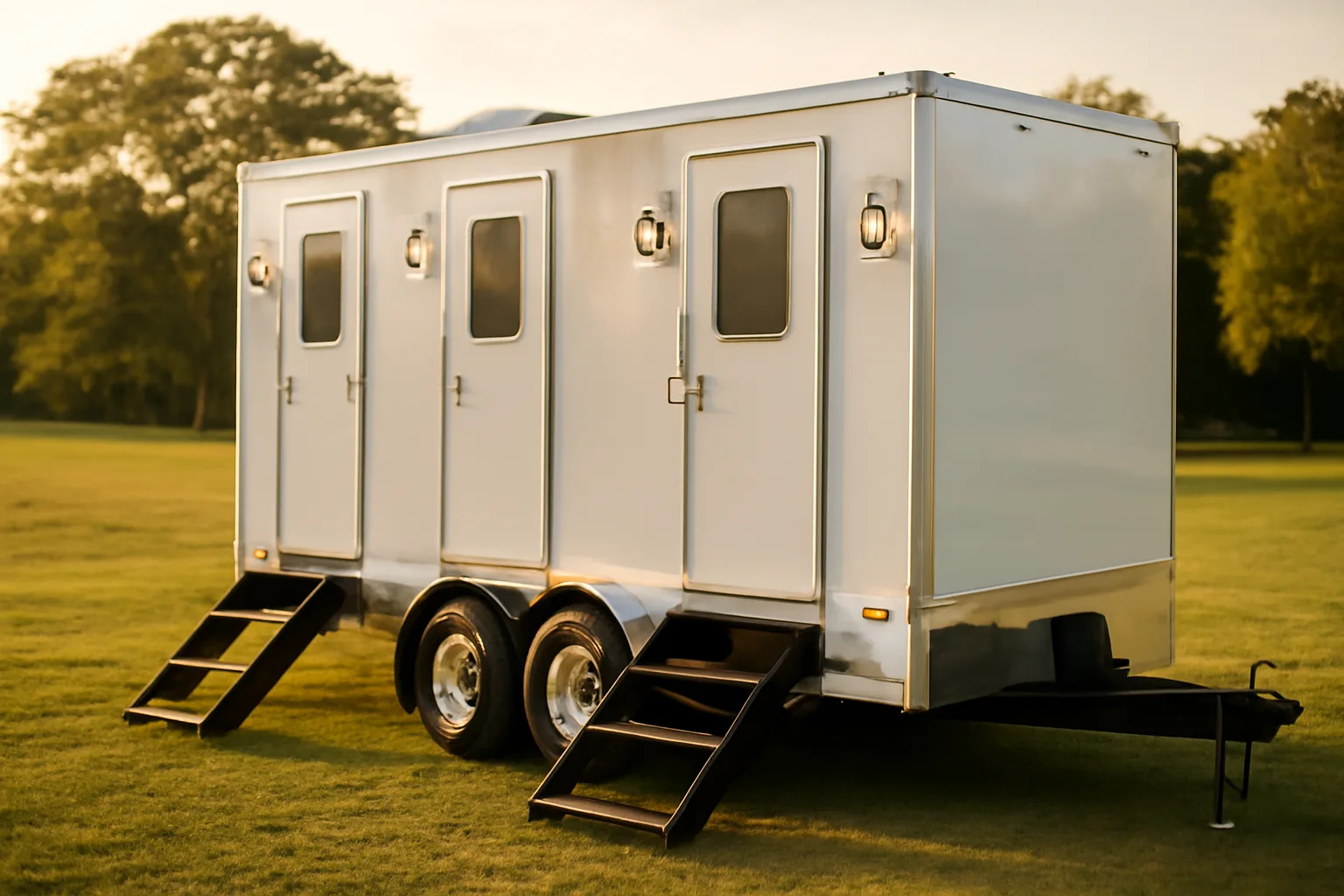
A luxury restroom trailer in Alabama costs between $25,000 and $60,000 for a 2-stall unit and $65,000 to $120,000 for a 4-stall trailer, depending on finishes like granite countertops, climate control, and sound systems. Those numbers come from major manufacturers’ public pricing, not from some state markup [4]. Alabama buyers pay the same as anyone in Georgia or Texas, because trailers ship from out-of-state factories.
A 2-stall basic luxury model with air conditioning, flush toilets, and a vanity starts around $25,000. Adding hardwood floors, music, and a bridal suite pushes that to $40,000 or more. The workhorses, 4-stall trailers with men’s and women’s sides, sit in the $70,000 to $85,000 range as of 2025. A 6-stall trailer with separate attendants’ areas can top $110,000.
If you’re just pricing out the renewal cost against your equipment, the $150 state license fee is pocket change compared to a single trailer purchase. Some operators budget for renewal alongside insurance, vehicle registration, and pumping costs, but the trailer itself is the real capital.
How much does the state license renewal cost in Alabama?
The ADPH Septage Management License renewal fee is $150 per year, according to the department’s current fee schedule [5]. That fee hasn’t changed in several years, but you should confirm the exact amount when you renew because fee schedules can shift.
There’s no discount for multiple trailers; the license covers the whole business. If you’re late, Alabama Code § 22-25B-17 allows civil penalties of up to $500 per day for operating without a license [8]. ADPH’s administrative practice adds a 50% surcharge on the license fee if you renew within 30 days after expiration, plus the late fee. After that, you might have to reapply as a new applicant.
Beyond the state fee, count on a local privilege license fee that varies wildly. In Birmingham, the business license renewal is based on gross receipts, so a restroom trailer business with $50,000 in revenue might pay $200 to $400 [6]. In smaller towns, it’s often a flat $50 to $100. Check with the county probate office or license commissioner.
How long does the luxury restroom trailer license renewal take in Alabama?
ADPH says online renewals via AOEHS are typically processed within 20 business days [3]. Mailed applications take the same time once received, but you lose a few days in transit. If your renewal is clean, no changes to your disposal site or vehicle roster, it can come through faster, sometimes in 10 business days.
The license renewal itself is an annual chore, and the clock starts when you submit. You should renew at least 30 days before your current license expires to avoid a gap. The expiration date prints on your license card. Some counties want to see the current state license before they’ll issue or renew the business privilege license, so a one-week delay can cascade.
The worst case is a lapsed license right before a wedding season rush. Clients expect proof of insurance and licensing; you can’t provide it with an expired state permit. Start renewal in late winter if your expiration is spring.
What local licenses and permits need renewal in Alabama?
Alabama requires almost every business to hold a state business privilege license, but in practice you get and renew that license through the county or municipality where you operate [6]. The process is separate from the ADPH septage license. Renewal is usually annual, due by January 1 or at your business anniversary date, and fees depend on your gross receipts or a flat minimum.
Some cities with a lot of event work, like Birmingham, Mobile, and Huntsville, enforce this strictly. A Mobile operator I know renews a City of Mobile business license and a Mobile County privilege license each year; it’s two separate payments. The county probate office handles the county one, and the city revenue department handles the city one.
If you serve multiple counties, you might need a privilege license in each county where you regularly do business, though some counties don’t enforce that for occasional jobs. Ask the probate judge in each county you’ll work in. Also, if you’re pumping and disposing of waste at a municipal treatment plant, you might need a discharge permit from that city; it’s usually part of the disposal agreement, not a standalone license.
What insurance requirements exist for luxury restroom trailer businesses in Alabama?
Alabama doesn’t require a specific insurance policy for portable toilet operators at the state level, but you’ll need it for two reasons. First, most wedding venues and event planners require proof of at least $1 million in general liability insurance before you can bring a trailer on site. Second, if you tow the trailers yourself, you must carry commercial auto insurance meeting Alabama’s minimum liability limits ($25,000 bodily injury per person, $50,000 per accident, $25,000 property damage) [9].
Smart operators carry $1 million to $2 million in commercial general liability. It’s not a law, it’s the price of admission to the luxury event market. Premiums for a small fleet typically run $800 to $1,500 annually through a business policy. You’ll include the insurance certificate in your renewal packet for venues and sometimes for ADPH if they request it.
Vehicle insurance is separate and must be renewed with the Alabama Department of Revenue’s motor vehicle registration. If your trailer’s gross vehicle weight rating exceeds 10,000 lbs, you may need a USDOT number and higher coverage; check with the Alabama Law Enforcement Agency.
What happens if you miss the renewal deadline in Alabama?
If you miss the ADPH renewal date, your license expires and you can’t legally operate. Alabama Code § 22-25B-17 sets a civil penalty of up to $500 per day for each violation of the onsite sewage laws, including operating without a current license [8]. ADPH’s practice, as stated in their enforcement procedures, is to issue a notice of violation and give a short window to correct it before fines mount.
You might also face a late renewal surcharge of 50% of the license fee if you renew within 30 days after expiration, pushing a $150 renewal to $225. After 30 days, you typically have to reapply as a new applicant, which means the full application with vehicle inspections and possibly a site visit.
Separately, missing your local privilege license renewal can trigger late fees from the county, often $50 to $100 per month. And if a venue asks for a current license and you can’t produce one, you’ll lose the booking. That’s the real cost.
How does renewal in Alabama compare to nearby states?
Georgia also requires a septage-related permit for portable restroom service, but its fee for the “portable toilet service provider” license is $50 per vehicle, not a flat business fee, so a fleet of three vehicles costs $150, same total but structured differently. Compare that to Georgia’s rules. Florida’s Department of Environmental Protection requires a “sanitary nuisance” permit that can cost upwards of $400 per year and has stricter waste tracking. Tennessee’s rules are lighter; many operators can operate with just a county business license and a general waste transport permit from the Department of Environment and Conservation. Read the Florida breakdown.
Alabama’s single-license approach is simpler than the county-by-county septage permits in Georgia, and the $150 fee is middle-of-the-pack. The key difference is that Alabama’s license is issued by the health department, while some states use the environmental agency, which can mean different inspection frequency.
What should first-year operators know about renewal timing and planning?
Most new operators don’t think about renewal until the reminder letter shows up. But if your initial license was issued in June, you’ll be renewing in May or June when the wedding season is heating up. You don’t want to be sitting on an expired license when a client calls for a July event. I recommend setting a recurring calendar alert for 60 days before expiration.
The simplest trick is to sync your local privilege license renewal with the state one, if the local office allows. Some counties will let you set the same expiration date. That way you do one big paperwork push once a year, not two separate cycles.
Also, keep a file with your vehicle registrations, disposal site contracts, and insurance certificate. ADPH may ask for these at renewal time if they haven’t seen an update in a while. It’s nothing dramatic, but having them ready means you can submit in 10 minutes.
LuxJohnPath’s $199 Wedding Trailer Spec Kit includes a renewal calendar template and a document checklist that walks you through exactly what each Alabama agency wants. It’s not required, but it’s the kind of thing that keeps you from forgetting a city license when you’re busy with weddings.
Are there any special waste disposal rules that affect renewal?
Alabama rules say you must dispose of waste from portable restrooms at a permitted receiving facility, usually a municipal wastewater treatment plant or a septage receiving station. ADPH wants to know your disposal site at renewal time, and they may verify that the facility is currently accepting septage [10]. If you changed facilities during the year, you’ll report the new site on the renewal form. There’s no extra fee for this change, but the department may request a copy of your contract with the treatment plant.
Some treatment plants require their own discharge permit for septage haulers. For example, the Riverchase plant in Shelby County asks for a $75 annual permit. That’s separate from ADPH, so you must track it yourself. If your disposal site drops out, your license renewal could be denied until you line up a new one, so have a backup.
Can you renew an Alabama luxury restroom trailer license online?
Yes, ADPH’s AOEHS portal handles renewals for septage management licenses. You’ll need the license number from your current card and the business’s federal EIN or your SSN. The system accepts credit cards and e-checks, and you can print a temporary license immediately after payment [2].
If you prefer paper, download the renewal form from the ADPH Onsite Sewage Program website, fill it out, and mail it with a check. That method takes the same 20 business days after they receive it. Online is faster and you can track the status, so I’d never use paper for a renewal that’s time-sensitive.
Frequently asked questions
Do you need a license for a luxury restroom trailer in Alabama?
Yes. Alabama Admin. Code r. 420-3-6-.27 requires anyone providing portable sanitation services to hold a Septage Management License from the Alabama Department of Public Health. This covers the rental, servicing, and waste disposal for all luxury restroom trailers operated under the same business.
How much does a luxury restroom trailer cost in Alabama?
A 2-stall luxury restroom trailer costs $25,000 to $60,000 depending on finishes, according to manufacturer pricing data. A 4-stall trailer runs $65,000 to $120,000, and a 6-stall can exceed $110,000. There’s no Alabama-specific markup; prices are similar nationwide.
How long does the luxury restroom trailer license renewal take in Alabama?
Online renewals through ADPH’s AOEHS portal are processed in about 20 business days. Paper forms take the same time after mailing. To avoid a lapse, submit at least 30 days before your current license expires.
Is there a luxury restroom trailer permit for individual events in Alabama?
No. The state septage license covers all events. However, the event venue or local jurisdiction may require its own permit or require proof of your state license and insurance. No Alabama law mandates a separate event permit for a luxury restroom trailer.
Do I need a CDL to tow a luxury restroom trailer in Alabama?
Not necessarily. If the combined weight of your tow vehicle and trailer exceeds 26,000 lbs and the trailer’s GVWR exceeds 10,000 lbs, you may need a Class A CDL. Many 2-stall trailers under 10,000 lbs do not require a CDL when towed with a suitable pickup. Check the Alabama Law Enforcement Agency for specific licensing.
What cities in Alabama require a separate privilege license for restroom trailers?
Most cities with substantial event traffic, like Birmingham, Mobile, Huntsville, Montgomery, and Tuscaloosa, require a city business privilege license. In unincorporated areas, the county license alone often suffices. Fees are typically based on gross receipts, starting around $75 to a few hundred dollars.
What happens if I operate a luxury restroom trailer in Alabama without a license?
Alabama Code § 22-25B-17 authorizes civil penalties up to $500 per day. The Department of Public Health can issue a cease-and-desist order, and you could face additional fines for not having proper waste disposal. Venues will refuse to work with an unlicensed operator.
How do I get liability insurance for a portable restroom business in Alabama?
Contact a commercial insurance broker experienced in event or sanitation businesses. Most operators carry $1 million in general liability, which costs $800 to $1,500 annually for a small fleet. This isn’t a state requirement, but venues demand it.
Can I renew my Alabama septage management license if my disposal site changes?
Yes. You report the new disposal facility on the renewal form. ADPH may ask for a copy of your new contract with the treatment plant. There’s no extra fee for this update, but you must have an approved site to maintain compliance.
How often do I need to renew the Alabama septage management license?
Annually. The license expires one year from the date of issuance, and you must submit your renewal before that date. ADPH sends a reminder, but it’s wise to set your own calendar alert.
What is the penalty for renewing late in Alabama?
ADPH imposes a 50% surcharge on the renewal fee if you renew within 30 days of expiration, making the $150 fee rise to $225. After 30 days, you may need to reapply as a new applicant. Civil penalties under law can be higher.
Sources
- Alabama Admin. Code r. 420-3-6-.27: All portable sanitation services shall be provided by a septage management entity licensed by the Department.
- Alabama Department of Public Health, Online Environmental Health System: Septage management license renewals are processed through the AOEHS portal with credit card payment.
- Alabama Department of Public Health, Septage Management Program: Renewals typically processed within 20 business days; operator must report any vehicle changes.
- Alabama Department of Public Health, Septage Management License fee schedule: Annual renewal fee for portable toilet operator license is $150.
- Alabama Department of Revenue, Business License: All businesses operating in Alabama must obtain and renew a privilege license through the county or municipality.
- Alabama League of Municipalities, Business License Information: Local business license fees are often based on gross receipts with minimums starting around $50.
- Ala. Code § 22-25B-17: Civil penalty of up to $500 per day for operating without a required septage management license.
- Alabama Department of Revenue, Mandatory Liability Insurance: Commercial vehicles must carry minimum auto liability insurance of $25,000/$50,000/$25,000.
- Alabama Admin. Code r. 420-3-6-.27(4): Portable toilet waste must be disposed at a permitted receiving facility; operator must provide disposal site information to ADPH.