Last updated 2026-08-18
TL;DR
Renting a luxury restroom trailer in Virginia typically costs $800, $3,500 per day depending on trailer size, stall count, and delivery distance. Buying a new unit runs $30,000, $150,000+. Operators need a Virginia contractor's license or wastewater hauler permit depending on their service model, and most permits take 2 to 8 weeks to secure.
How much does a luxury restroom trailer cost in Virginia?
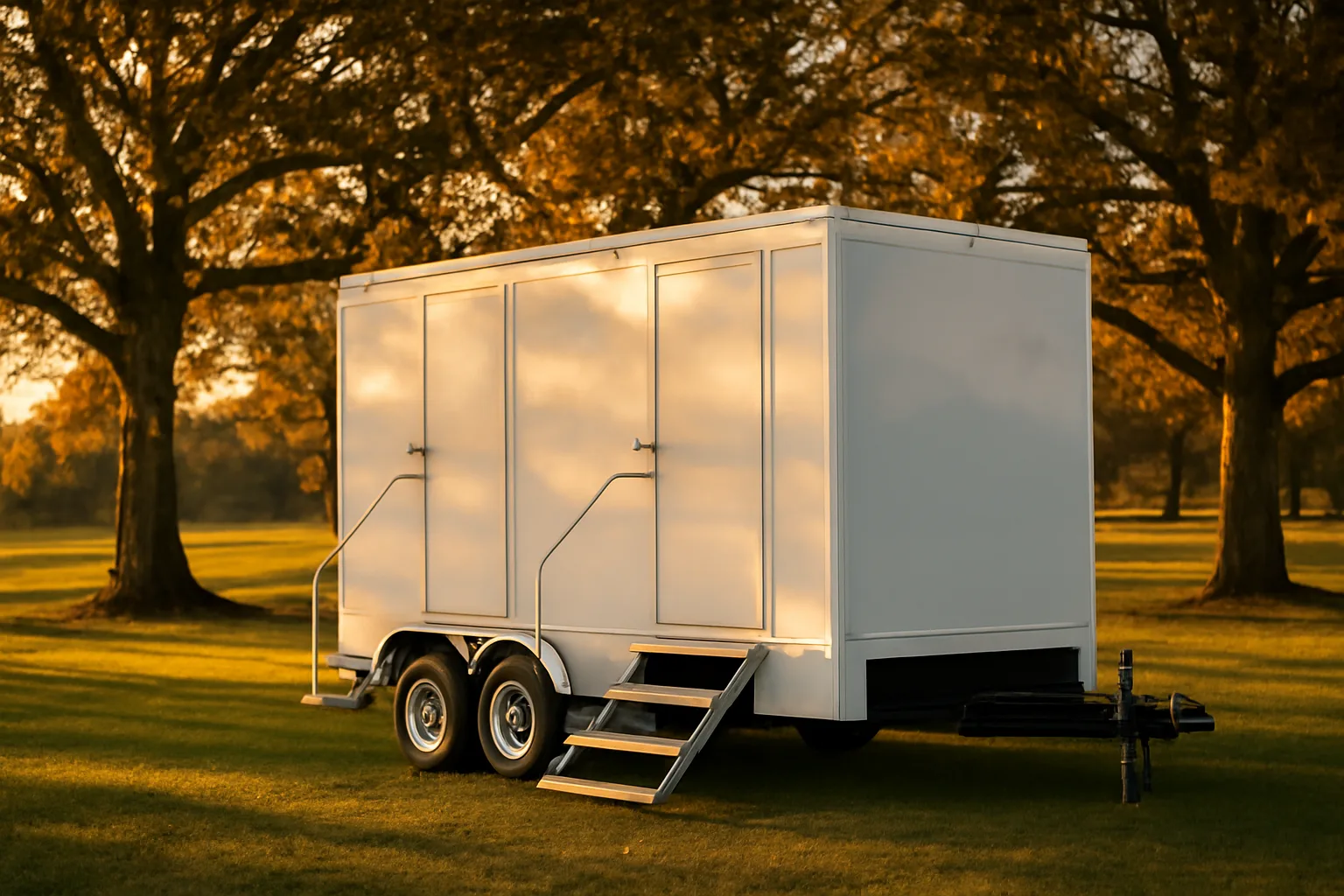
Rental rates for a luxury restroom trailer in Virginia generally land between $800 and $3,500 per day, with most two-to-four stall units booked at events in the $1,200, $2,200 range. Smaller two-station trailers come in closer to $800, $1,100. Eight-station or climate-controlled showpiece trailers for large weddings or corporate events push past $2,500 and can exceed $3,500 for a full weekend package once you add delivery, water connection, and attendant service.
Delivery fees in Virginia vary sharply by geography. A Northern Virginia drop in Fairfax or Loudoun County from a DC-metro supplier might add $150, $350. A delivery to rural Shenandoah or Southside Virginia can run $500, $800 round-trip. Always ask for a fully itemized quote, not a base rate.
Buying your own trailer is a different math problem. A new two-stall luxury unit from manufacturers like Satellite Industries or CALLAHEAD starts around $30,000, $40,000. A well-appointed four-to-six stall trailer with hardwood floors, porcelain sinks, and a generator package runs $70,000, $110,000. The largest custom ten-plus stall trailers for high-volume operators can exceed $150,000. [1]
Used units trade at roughly 50 to 70 percent of original cost in years two through four, assuming good mechanical condition. Virginia's climate is mild enough that depreciation from freeze damage is lower than in northern states, which matters if you buy used from out of state.
If you're comparing states, luxury restroom trailer cost in Florida runs similarly for rentals but purchase prices can differ due to dealer concentration in the southeast.
What drives rental pricing differences inside Virginia?
Three factors move the price more than anything else: stall count, distance from the supplier's yard, and the season.
Stall count is straightforward. Each additional stall adds plumbing, fixtures, and square footage. A six-stall trailer costs meaningfully more than a three-stall unit even from the same company.
Distance is the one buyers most underestimate. Virginia is a large state. A supplier based in Richmond serves the Tidewater corridor affordably but charges real money to reach the New River Valley or the Northern Neck. If you're planning an event in a rural county, get quotes from at least two suppliers before assuming one vendor's rate card is representative.
Season matters a lot in Virginia's event market. Spring (April through June) and fall (September through October) are peak wedding and festival seasons. Rates at peak can run 15 to 25 percent above the same company's January prices, and availability dries up fast. Northern Virginia's proximity to DC also means any large federal event season can push demand unpredictably.
A few other cost levers worth knowing: some companies charge separately for a gray water pump-out if your site has no sewer hookup, typically $150, $300. Propane or generator rental for climate control adds $75, $200 per day. An on-site attendant, which many upscale clients require, runs $25, $50 per hour in most Virginia markets. None of those appear in a base rental quote.
Do you need a license to operate a luxury restroom trailer business in Virginia?
Yes, but the specific license depends on what your business model looks like. Virginia has two overlapping regulatory tracks for restroom trailer operators.
First, if your trailer connects to a temporary water supply or discharges waste to a holding tank that you then haul and dispose of, you need a Virginia Sewage Handling and Disposal permit under the Virginia Department of Health's Onsite Sewage and Water programs. The relevant authority is the Virginia Department of Health Office of Environmental Health Services. Portable sanitation haulers operating in Virginia must comply with the Sewage Handling and Disposal Regulations, 12 VAC 5-610. [2]
Second, if you operate as a contractor setting up and breaking down event infrastructure, Virginia's contractor licensing rules under the Department of Professional and Occupational Regulation may apply. The Virginia contractor licensing framework under Title 54.1 of the Code of Virginia covers firms doing construction-adjacent work; confirm with DPOR whether your specific service model triggers a Class A, B, or C contractor license. [3]
For most pure rental operators, the document that matters is the VDH permit for waste hauling, not a contractor license. But if you're doing site prep, plumbing connections to a venue's water system, or permanent tie-ins, the contractor license question becomes real.
Business entity registration is a separate step. You'll file with the Virginia State Corporation Commission to form your LLC or corporation before you apply for any operational permits. [4] The SCC filing fee for a Virginia LLC was $100 as of 2024; confirm current fees with the SCC directly.
Local county or city business licenses (often called a Business, Professional, and Occupational License, or BPOL) are required in most Virginia localities on top of state permits. Loudoun, Fairfax, Henrico, and Virginia Beach all have BPOL programs. Rates are revenue-based and typically range from $0.10 to $0.36 per $100 of gross receipts depending on your business category. [5]
How long does licensing and permitting take in Virginia?
Realistically, budget 4 to 10 weeks from start to fully operational, depending on which permits you need and how complete your applications are.
Virginia SCC entity registration is the fastest step. An online LLC filing through the SCC Clerk's Information System typically processes in 1 to 5 business days. [4]
VDH sewage hauler permits take longer. The Virginia Department of Health processes applications through local health districts, and timelines vary by district workload. Most applicants report 3 to 6 weeks for a straightforward hauler permit, but rural districts with smaller staffs can run 6 to 10 weeks. Submit a complete application with vehicle information, proposed disposal site documentation, and any required inspection scheduling upfront to avoid back-and-forth delays.
Local BPOL licenses are usually the easiest. Most Virginia localities process them within 5 to 15 business days once you have your state registration in hand.
If a DPOR contractor license is required for your model, that timeline extends. DPOR license applications that require a trade exam can take 8 to 12 weeks or longer depending on exam scheduling. [3] If your model doesn't require the exam (some Class C licenses don't), processing is faster.
One practical note: do not schedule your first event before your VDH waste hauler permit is in hand. Hauling and disposing of waste without that permit is a violation of the Sewage Handling and Disposal Regulations and can result in civil penalties. Virginia's penalty schedule under 12 VAC 5-610 allows fines per violation per day.
What does a new luxury restroom trailer actually include at each price point?
Price point drives what you get more than any marketing language. Here's an honest look at what different purchase budgets buy you.
At $30,000, $50,000 you typically get a two-to-three stall trailer with laminate or vinyl flooring, basic vanity fixtures, a fresh water tank, a holding tank, and a small HVAC unit. These trailers work fine for casual outdoor events but they don't pass as "luxury" to a client who has seen the high-end product.
At $55,000, $90,000 you get the real luxury tier for most markets: hardwood or tile floors, porcelain sinks, full-length mirrors, climate control that actually performs, interior lighting that looks designed rather than utilitarian, and four to six stalls. Most Virginia wedding market operators buy in this range.
Above $90,000 you're into high-capacity or highly customized units: eight-plus stalls, dedicated men's and women's sides, full generator systems, exterior lighting packages, and premium finishes that rival a nice hotel restroom. These serve large festivals, corporate events, and estate weddings with 300-plus guests.
Running costs after purchase include insurance (see the insurance section below), annual vehicle registration and inspection, holding tank pump-out costs ($75, $200 per service), generator maintenance, and cleaning supplies. A realistic first-year operating cost model for a single-trailer Virginia operator, excluding debt service, runs $8,000, $20,000 depending on how many events you work and how far you drive. [1]
For a different geographic comparison, see luxury restroom trailer cost in Georgia which covers a similarly warm-season-heavy market with different dealer density.
What does insurance cost for a luxury restroom trailer in Virginia?
Insurance is not optional and it's not cheap. A Virginia operator running one or two luxury trailers should budget for three coverages.
Commercial auto insurance covers the tow vehicle and trailer in transit. For a trailer valued at $70,000, expect $1,800, $3,500 per year for commercial auto depending on your driving record, the tow vehicle, and the insurer. Virginia sets minimum liability limits for commercial vehicles under Title 46.2 of the Code of Virginia, but those minimums are low; most operators carry $500,000 combined single limit or more. [6]
General liability insurance covers property damage and bodily injury at the event site. A $1 million per occurrence, $2 million aggregate policy for a portable sanitation business in Virginia typically runs $900, $2,200 per year. Some venue contracts in Northern Virginia and the Richmond suburbs require $2 million per occurrence; check your venue contract before buying a policy.
If you hire employees, Virginia requires workers' compensation coverage for any business with two or more employees under the Virginia Workers' Compensation Act. [7] For a small trailer operation, this adds $1,500, $4,000 annually depending on payroll and job classification.
Total first-year insurance outlay for a solo Virginia luxury restroom trailer operator: roughly $4,000, $9,000. That's a real line item in your startup budget, not a footnote.
What do Virginia event venues and clients expect from a luxury restroom trailer?
Virginia's wedding and event market is well-developed, especially in the Northern Virginia wine country corridor (Loudoun and Fauquier counties), the Richmond area, and coastal markets around Virginia Beach and the Eastern Shore. Clients in these markets have seen luxury trailers before. They have expectations.
The minimum bar for a Virginia estate wedding client is climate control that works, interior lighting that photographs well, fresh flowers or a simple interior décor option, and a restroom that doesn't smell like a portable toilet. If your trailer can't clear that bar, you will not get repeat bookings or referrals in this market.
Venue coordinators at Loudoun County farm venues often require proof of insurance, a wastewater disposal plan, and sometimes a permit copy before confirming your vendor slot. Get these documents ready in a vendor packet before you start marketing.
For events with 150 or more guests, the general guidance from the portable sanitation industry is one toilet stall per 50 to 75 guests for events under four hours, adjusted for alcohol service. Virginia's Department of Health does not publish a specific luxury trailer ratio requirement separate from the general portable restroom guidelines, but the event planning industry uses the Portable Sanitation Association International's (PSAI) service guidelines as a practical benchmark. [8]
If you're buying your first trailer and want a structured spec guide for matching trailer configurations to Virginia wedding market demands, LuxJohnPath's Wedding Trailer Spec Kit ($199, one-time) at /start covers trailer configurations, client contract terms, and vendor packet templates. It's a planning document, not a permit service.
How does Virginia compare to neighboring states on cost and regulation?
Virginia sits in a mid-range position among Atlantic seaboard states for both startup costs and regulatory burden.
Maryland and DC have more complex wastewater disposal requirements and higher permit costs due to Chesapeake Bay watershed regulations. North Carolina has a similar VDH-analog permit structure but generally lower delivery costs due to lower fuel and labor costs in rural areas. [9]
| State | Typical rental range (per day) | Key permit agency | LLC filing fee |
|---|---|---|---|
| Virginia | $800, $3,500 | VDH / DPOR | $100 |
| Maryland | $900, $3,800 | MDE | $150 |
| North Carolina | $700, $3,200 | NCDEQ | $125 |
| Tennessee | $650, $2,900 | TDEC | $300 |
| Georgia | $750, $3,300 | EPD | $100 |
Note: LLC fees and rental ranges are approximate and based on publicly available fee schedules and market surveys as of 2024 to 2025. Confirm current agency fees directly. [4]
For operators near the Virginia-Tennessee or Virginia-North Carolina border, checking both states' requirements before choosing a base of operations is worth the time. You may find your primary market is across the state line, which changes your permit obligations entirely.
See luxury restroom trailer cost in North Carolina for a different market data point, or luxury restroom trailer cost in Colorado if you're evaluating western markets.
What are the real startup costs for a luxury restroom trailer business in Virginia?
People underestimate the gap between "I bought the trailer" and "I'm making money." Here's an honest first-year cost picture for a single-trailer Virginia operation.
Trailer purchase: $55,000, $90,000 for a market-competitive four-to-six stall unit. If you finance, expect 7 to 10 percent interest rates on a commercial equipment loan as of 2024 to 2025 from banks and equipment finance companies. [10] Down payment requirements vary but 10 to 20 percent is typical.
Tow vehicle: $45,000, $85,000 for a new three-quarter or one-ton diesel truck with adequate tow ratings. Used trucks in good condition are available for $25,000, $45,000. Your trailer's GVWR matters here; verify your truck's rated tow capacity against the loaded trailer weight before buying either.
Permits and licenses: $500, $2,500 total including SCC filing, VDH permit, local BPOL, and any DPOR fees.
Insurance (first year): $4,000, $9,000.
Marketing, website, and vendor listing fees: $1,500, $5,000 for a realistic first year.
Operating supplies (cleaning, chemicals, linens, décor): $1,000, $3,000.
Total first-year cash outlay, excluding trailer and truck financing: $7,000, $19,500. With trailer and truck: $107,000, $197,000 all-in if purchased outright. Most operators finance the equipment and pay the rest from cash.
Break-even on a $75,000 trailer at an average rental rate of $1,600 per booking with 60 percent gross margin requires roughly 78 bookings. At 15 bookings per month during a 7-month Virginia event season, that's a little over one full season. Realistic for a well-marketed operation. Tight if your marketing is weak.
For comparison on how startup math works in a similar state, see luxury restroom trailer cost in Alabama.
Where can you dispose of waste legally in Virginia?
This is the question that catches new operators off guard. You can't just dump your holding tank anywhere. Virginia requires portable sanitation waste (classified as sewage) to be disposed of at a permitted sewage treatment facility or an approved disposal site. [2]
Most Virginia luxury trailer operators use one of three legal disposal paths: a permitted wastewater treatment plant that accepts hauled sewage, a permitted pump station with a receiving point, or in some rural areas a permitted land application site. Not all treatment plants accept hauled waste; you need to arrange a disposal agreement with a facility before your first event.
The Virginia Department of Health maintains oversight of sewage hauling through its local health district offices. Finding a disposal site is your responsibility as the permittee, and you need to document your disposal at each event. Good record-keeping here is not optional; it's what protects your permit if you're ever audited.
Some Virginia operators subcontract disposal to an established septic pumping company that already has hauler permits and disposal relationships. That's a reasonable approach when you're starting out, but factor the cost into your pricing. Subcontracted pump-out plus disposal typically runs $100, $250 per event.
The Virginia Administrative Code section governing this is 12 VAC 5-610, the Sewage Handling and Disposal Regulations. It's long but Part III specifically covers hauled sewage, and reading it once before you apply for your permit will save you a round of corrections.
What to look for when renting vs. buying in Virginia
If you're an event host looking to rent, the checklist is shorter than you think. Confirm the supplier holds a current VDH hauler permit (ask for the permit number, then verify with your local health district). Ask for proof of general liability insurance with a $1 million minimum. Get a fully itemized written quote that includes delivery, setup, any pump-out during the event, and pickup. Confirm who is responsible for gray water disposal after the event.
For buyers and future operators, the decision to buy versus rent your first event unit is worth thinking through carefully. Renting a trailer from a competitor to staff your first two or three events is not a bad strategy. You learn the setup process, understand what clients actually complain about, and generate revenue before committing $80,000 to a purchase. A few Virginia operators have run a rent-to-test model for one season before buying.
If you decide to buy, the manufacturer warranty terms matter. Most reputable manufacturers warrant the trailer structure for one to three years and plumbing components separately. Get the warranty in writing and understand what voids it.
LuxJohnPath publishes independent pricing and equipment guides for this industry. The /start page connects you to the Wedding Trailer Spec Kit if you want a structured template for the buying decision.
Frequently asked questions
How much does a luxury restroom trailer rental cost for a Virginia wedding?
Most Virginia wedding rentals run $1,200, $2,500 for a four-to-six stall trailer for a single day, including delivery within 60 miles of the supplier's yard. Add $150, $500 for delivery to rural counties. Climate control, an on-site attendant, and pump-out services cost extra. Get a fully itemized quote in writing before signing anything.
Do you need a license for a luxury restroom trailer business in Virginia?
Yes. At minimum you need a Virginia VDH sewage hauler permit under 12 VAC 5-610. You also need to register your business with the Virginia State Corporation Commission. Local BPOL business licenses apply in most cities and counties. If your work involves plumbing tie-ins or contractor-style setup, a DPOR contractor license may also apply. Confirm your specific situation with VDH and DPOR directly.
How long does it take to get a restroom trailer hauler permit in Virginia?
Most applicants report 3 to 6 weeks for a VDH sewage hauler permit if the application is complete. Rural health districts with smaller staff can take 6 to 10 weeks. SCC entity registration typically takes 1 to 5 business days online. Budget 4 to 10 weeks total from first application to fully operational. Do not schedule events before your VDH permit arrives.
What is the purchase price range for a luxury restroom trailer in Virginia?
New luxury restroom trailers sell in a wide range: $30,000, $50,000 for basic two-to-three stall units, $55,000, $90,000 for mid-tier four-to-six stall trailers suited for the Virginia wedding market, and $90,000, $150,000+ for large custom units. Used trailers trade at roughly 50 to 70 percent of original value in years two through four if mechanically sound.
What permits does a luxury restroom trailer operator need in Virginia?
The core permits are: a VDH sewage hauler permit (12 VAC 5-610), a Virginia SCC business entity registration, and a local BPOL business license for the county or city where you're based. Depending on services offered, a DPOR contractor license may be required. Some venues also require proof of general liability insurance and a waste disposal plan before allowing you on-site.
How much does insurance cost for a luxury restroom trailer in Virginia?
A realistic first-year insurance budget for a solo Virginia operator is $4,000, $9,000. That covers commercial auto ($1,800, $3,500), general liability ($900, $2,200), and workers' compensation if you have employees ($1,500, $4,000). General liability minimums required by Northern Virginia venue contracts are often $1 to 2 million per occurrence, so buy at that level, not the state minimum.
How many restroom stalls do you need for a Virginia outdoor event?
The Portable Sanitation Association International's service guidelines recommend roughly one stall per 50 to 75 guests for events under four hours, adjusted upward for alcohol service. For a 150-guest Virginia wedding, a four-to-six stall luxury trailer is typically sufficient. Virginia's Department of Health does not publish a separate luxury trailer ratio rule distinct from general portable sanitation guidelines.
Where can you legally dump restroom trailer waste in Virginia?
Waste must go to a permitted sewage treatment facility or an approved disposal site. Not all treatment plants accept hauled sewage; you need a prior disposal agreement. Some operators subcontract to licensed septic pumping companies. Disposal is governed by 12 VAC 5-610. Document every disposal event; good records protect your VDH permit in an audit.
How much does delivery add to luxury restroom trailer rental cost in Virginia?
Delivery fees vary significantly. Northern Virginia deliveries from DC-area suppliers typically add $150, $350. Deliveries to rural Shenandoah Valley, Southside Virginia, or the Northern Neck can add $500, $800 round-trip. Always ask for a fully itemized quote that separates the delivery fee from the base rental rate, and confirm whether fuel surcharges apply.
What is the first-year startup cost for a luxury restroom trailer business in Virginia?
All-in, including a financed trailer and tow vehicle, expect $107,000, $197,000 in year one if purchasing equipment outright. If you finance equipment, first-year cash needs outside of financing (insurance, permits, marketing, supplies) run $7,000, $19,500. Break-even on a $75,000 trailer at $1,600 average revenue per booking with 60 percent gross margin takes roughly 78 bookings.
Do Virginia restroom trailer operators need a contractor license?
It depends on the scope of work. Pure rental and hauling operations typically do not trigger a DPOR contractor license. If you connect to venue plumbing, do site prep, or perform construction-adjacent work, Title 54.1 of the Code of Virginia may require a Class A, B, or C license. Confirm your specific service model with DPOR before operating.
Is it worth buying a luxury restroom trailer versus renting one out from an existing company in Virginia?
Buying makes sense if you can consistently book 12 to 20 events per season at market rates and have the capital or financing for a $55,000, $90,000 purchase. Renting your first event or two from a competitor to learn the workflow before buying is a legitimate strategy several Virginia operators have used. Evaluate your booked demand before committing to equipment.
How do seasonal demand patterns affect luxury restroom trailer pricing in Virginia?
Spring (April through June) and fall (September through October) are peak seasons in Virginia's event market. Rates can run 15 to 25 percent above off-peak prices during these windows, and trailer availability tightens significantly. Book early for spring and fall events. Northern Virginia's proximity to DC adds unpredictable demand spikes around federal event schedules.
What should a Virginia event host check before renting a luxury restroom trailer?
Ask the supplier for their VDH hauler permit number and verify it with the local health district. Get proof of $1 million minimum general liability insurance. Request a fully itemized written quote covering delivery, setup, any mid-event pump-out, and pickup. Confirm who handles gray water disposal after the event and that it goes to a permitted facility.
Sources
- Portable Sanitation Association International, Industry Overview and Equipment Resources: New luxury restroom trailer purchase price ranges from approximately $30,000 for basic units to over $150,000 for large custom configurations
- Virginia Administrative Code, 12 VAC 5-610, Sewage Handling and Disposal Regulations: Virginia requires portable sanitation haulers to hold a VDH permit and dispose of waste only at permitted facilities under 12 VAC 5-610
- Virginia Department of Professional and Occupational Regulation, Contractor Licensing: Virginia's contractor licensing framework under Title 54.1 governs firms doing construction-adjacent work, with Class A, B, and C license tiers
- Virginia State Corporation Commission, Business Entity Formation and Fees: Virginia LLC formation is filed with the SCC and the filing fee was $100 as of 2024; online filings typically process in 1 to 5 business days
- Code of Virginia, Title 58.1, Chapter 37, Business, Professional, and Occupational License (BPOL) Tax: Most Virginia localities require a BPOL license with rates ranging from $0.10 to $0.36 per $100 of gross receipts depending on business category
- Code of Virginia, Title 46.2, Motor Vehicles: Virginia sets minimum commercial vehicle liability requirements under Title 46.2; most operators carry $500,000 combined single limit or more
- Code of Virginia, Title 65.2, Virginia Workers' Compensation Act: Virginia requires workers' compensation coverage for businesses with two or more employees under the Virginia Workers' Compensation Act
- Portable Sanitation Association International, Service Frequency and Staffing Guidelines: PSAI guidelines recommend approximately one stall per 50 to 75 guests for events under four hours, adjusted for alcohol service
- North Carolina Department of Environmental Quality: North Carolina has a VDH-analog permit structure for portable sanitation haulers through NCDEQ
- Federal Reserve, Small Business Lending Survey, Q3 2024: Commercial equipment loan interest rates in 2024 to 2025 generally ranged from 7 to 10 percent depending on borrower creditworthiness and loan term