Last updated 2026-08-18
TL;DR
Starting a luxury restroom trailer business in Virginia means registering an LLC or corporation with the State Corporation Commission, getting a DEQ permit for a portable sanitation operation, carrying commercial auto and general liability insurance, and buying or financing a trailer that runs $45,000 to $120,000 new. No single statewide 'luxury restroom license' exists; the paper path is business registration plus environmental permitting.
What licenses and permits do you actually need in Virginia?
There is no standalone "luxury restroom trailer license" issued by Virginia. What the state actually requires is a mix of business entity registration, an environmental operating permit, and in some localities a business license. Each layer comes from a different agency. That's where most new operators get lost.
First, you register your business entity with the Virginia State Corporation Commission. An LLC is the most common choice for a sole operator. The SCC filing fee for an LLC is $100 as of the current fee schedule [1]. You file online at the SCC's Clerk's Information System, and approval usually comes back within 1 to 3 business days for online filings.
Second, and this is the piece most guides skip, you need to comply with Virginia DEQ regulations on portable sanitation. Virginia regulates the hauling and disposal of sewage under the Virginia Pollution Abatement permit program run by the Department of Environmental Quality. Operators who transport, store, or dispose of wastewater from portable restrooms fall under these rules [2]. The specific permit requirement depends on volume hauled and disposal method. Call your regional DEQ office before you buy the trailer, because the disposal site (a licensed septage receiving facility or municipal treatment plant) has to be arranged in advance.
Third, Virginia localities impose their own business license taxes under the Business, Professional, and Occupational License (BPOL) tax system. The rate varies by locality and gross receipts category [3]. Check with the treasurer's office in the county or independent city where your business is based.
Finally, if you tow a trailer over 10,000 lbs gross vehicle weight rating, you may need a Commercial Driver's License (CDL) in Virginia. Many 3-station luxury trailers loaded with water come in under that threshold, but confirm the GVWR of the specific trailer you buy and check Virginia DMV rules [4].
How do you register the business entity in Virginia?
Go straight to the Virginia SCC Clerk's Information System (CIS) at cisiweb.scc.virginia.gov. You can form an LLC entirely online in about 20 minutes. The $100 filing fee covers the Articles of Organization. You need a registered agent with a Virginia street address, which can be you personally if you have a physical Virginia address, or a registered agent service that typically costs $50 to $150 a year [1].
Pick a name that does not conflict with an existing entity. The SCC's name availability search sits on the same CIS portal. You can reserve a name for $10 if you're not ready to file.
After the SCC approves the entity, get an Employer Identification Number (EIN) from the IRS. It's free, done online at irs.gov, and takes about 5 minutes. You need the EIN to open a business bank account, which you should do before you take any deposits.
Virginia does not require a general statewide business license beyond the SCC registration and local BPOL filings. Don't confuse "no state business license" with "no other permits." The DEQ and DMV layers are real, and they carry real penalties if you ignore them.
What does Virginia DEQ require for portable sanitation operators?
This is the most underestimated step in the whole process. Virginia Code Section 62.1-44.19:3 gives DEQ authority to regulate pollution abatement, which extends to companies that pump, haul, or dispose of sewage from portable restrooms [2]. The practical requirement: you must have a legal disposal arrangement before you operate.
Virginia DEQ's Virginia Pollution Abatement (VPA) permit program covers facilities and operations that apply or dispose of waste. A luxury restroom trailer operation usually qualifies as a "portable toilet pumping service" for permitting purposes. Contact your regional DEQ office (there are seven across the state) to confirm whether your specific operation and disposal method triggers a VPA permit or falls under a general permit or registration. Disposal volume matters. Smaller operations sometimes qualify for an agricultural land application exemption if a landowner accepts the effluent under DEQ's land application rules, but that is a niche path and requires its own paperwork.
The most practical disposal option for most Virginia operators is a contract with a local wastewater treatment plant or a licensed septage receiving facility. Tipping fees at Virginia treatment plants vary widely. $0.03 to $0.08 per gallon is a commonly cited range in the industry, though you'll need to confirm with the specific facility because public rates differ from private ones.
Get this disposal contract lined up before you buy the trailer. Some treatment plants have capacity limits or require advance approval for new commercial accounts.
How much does a luxury restroom trailer cost in Virginia?
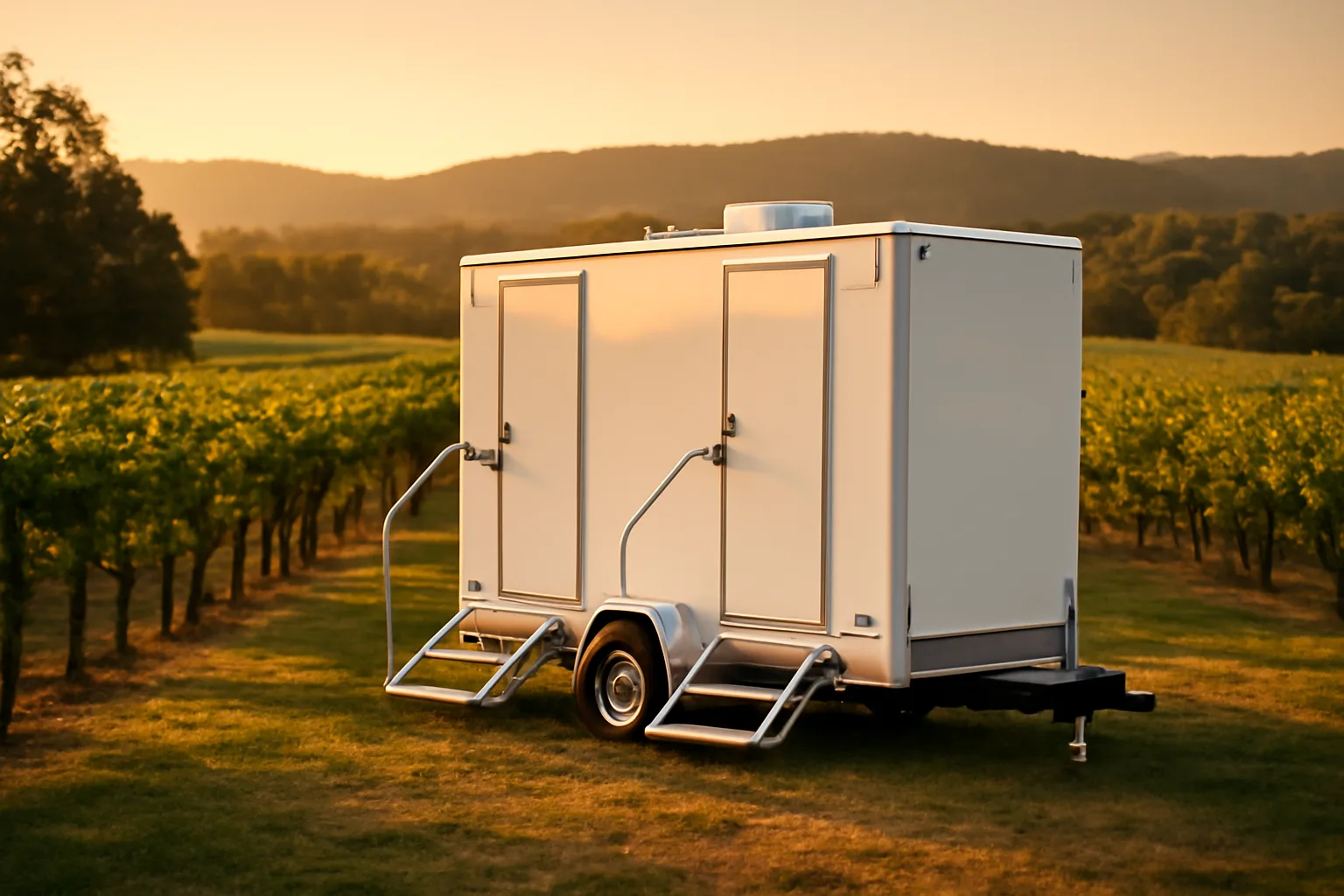
The trailer itself is the biggest number. New luxury restroom trailers in the United States range from roughly $45,000 for a basic 2-station unit to over $120,000 for a large 8-station trailer with hardwood floors, climate control, and high-end fixtures [5]. The most common entry-point purchase for a new Virginia operator is a 3- or 4-station trailer in the $55,000 to $80,000 range.
Used trailers sell for 30% to 60% of new price depending on age, condition, and how many hours the generator has on it. A 5-year-old 3-station trailer in decent shape might go for $25,000 to $40,000. The risk with used is that holding tanks, plumbing valves, and generator components can be expensive to repair if the previous owner deferred maintenance.
Beyond the trailer, your first-year startup costs in Virginia look roughly like this:
| Item | Estimated Cost |
|---|---|
| Luxury restroom trailer (new, 3-4 station) | $55,000, $80,000 |
| Tow vehicle (if not already owned) | $35,000, $65,000 |
| Virginia SCC LLC filing | $100 |
| Registered agent (annual) | $50, $150 |
| DEQ permit fees (varies; confirm with DEQ) | $300, $1,500 est. |
| Local BPOL license (varies by locality) | $50, $500 est. |
| Commercial general liability insurance | $1,500, $4,000/yr |
| Commercial auto insurance | $2,000, $5,000/yr |
| Supplies and consumables (first year) | $1,500, $3,000 |
| Marketing and website | $500, $3,000 |
These are real-world ranges, not guarantees. Your tow vehicle cost is zero if you already own a capable truck. Insurance quotes swing hard based on coverage limits and your driving record.
Financing is available through equipment lenders and some trailer manufacturers. A $65,000 trailer financed over 60 months at 7% runs about $1,285 per month. A single weekend wedding rental in Northern Virginia typically bills at $800 to $1,800 depending on unit size and rental duration, so the math on return works reasonably well if you're booking regularly.
How long does it take to get up and running in Virginia?
If you move fast on every step, you can be legally operating in 4 to 8 weeks. Realistically, most new operators take 3 to 5 months, because DEQ permitting, trailer delivery, and insurance binding don't all happen at once.
Here's a rough sequence:
Week 1: File LLC with SCC (1-3 day approval for online filings), get EIN from IRS (same day), open business bank account.
Week 2-3: Contact regional DEQ office, describe your operation, and ask what permit or registration is required. Start the permit application if needed. At the same time, get commercial auto and general liability insurance quotes.
Week 3-4: Apply for local BPOL license with your county or city treasurer. Negotiate a disposal contract with a wastewater treatment plant or septage facility.
Week 4-8: DEQ permit processing time varies by permit type and regional office workload. A registration or general permit can sometimes be granted in 2 to 4 weeks. A full VPA permit takes longer. Confirm current processing times directly with DEQ.
Week 4-12: Order or locate the trailer. New trailers from U.S. manufacturers have lead times of 8 to 16 weeks. Used trailers bought privately or through dealers move faster.
DEQ permitting and trailer delivery are the two longest poles in the tent. Run them in parallel instead of one after the other, and you cut weeks off the total.
What insurance do you need for a Virginia restroom trailer operation?
Two policies are the floor. Commercial general liability (CGL) covers bodily injury and property damage claims that come out of your operation at an event site. Wedding venues and corporate event coordinators in Virginia almost always require a certificate of insurance showing at least $1 million per occurrence, and many require $2 million. Budget $1,500 to $4,000 per year for CGL depending on revenue and coverage limits.
Commercial auto insurance covers the tow vehicle and the trailer while in transit. A standard personal auto policy will not cover a vehicle used for commercial purposes. Expect $2,000 to $5,000 per year, though rates swing with driving history and vehicle.
Some operators add inland marine or equipment floater coverage to protect the trailer itself against damage. That's worth considering once your unit is paid off, or if you financed and the lender requires it.
Virginia does not mandate workers' compensation for sole proprietors or single-member LLCs with no employees. The moment you hire a helper, even part-time, Virginia law requires workers' comp coverage [6].
What does the Virginia market actually look like for restroom trailer rentals?
Virginia is a strong market. The state has a dense wedding corridor in Northern Virginia and the Shenandoah Valley, a busy corporate event scene in Richmond and Charlottesville, and regular outdoor festivals and political events in the D.C. suburbs. The outdoor wedding market alone runs roughly April through October, with peak demand in May, June, September, and October.
Rental rates in Virginia for a 3-station luxury trailer run $800 to $1,400 for a day rental at a private event. Larger 6- to 8-station units at upscale wineries or vineyard weddings can bill $1,500 to $2,500 per event. Multi-day construction or film production rentals bill differently, usually at a weekly rate.
Saturation varies by region. Northern Virginia has more established operators than rural Southwest Virginia. If you're entering a market with existing competitors, differentiation through trailer condition, attendant service, or niche targeting (micro-weddings, corporate only) matters more than price.
For operators thinking hard about specs for the wedding market, a document that maps out exact restroom-to-guest ratios, water tank sizing, and generator requirements for Virginia-sized wedding venues can save you from buying the wrong unit. LuxJohnPath's Wedding Trailer Spec Kit covers that calculation in detail for $199 as a one-time purchase.
Want to see how Virginia's regulatory setup lines up against nearby states? how to start luxury restroom trailer in Alabama and how to start luxury restroom trailer in Arkansas run through those states' specific paper paths.
How do you find and vet a luxury restroom trailer manufacturer or dealer?
The Portable Sanitation Association International (PSAI) maintains a member directory that includes trailer manufacturers and distributors [7]. That's a reasonable starting point, because PSAI members are at least committed enough to pay dues and show up at industry events.
The major U.S. luxury restroom trailer manufacturers include B&B Trailers, Comfort Stations, and Luxury Restrooms. All three have dealer networks and ship to Virginia. Lead times run 8 to 16 weeks for new custom builds as of the most recent industry reporting.
When you're evaluating a trailer, ask specifically about holding tank capacity (gallons per flush station per event), fresh water tank size, generator brand and hours, axle weight rating, and what the winterization process looks like. Virginia gets real winters in the mountains and periodic hard freezes in the Tidewater region, so winterization matters.
Get a pre-purchase inspection from an independent RV or trailer mechanic before buying used. Holding tanks with cracks or bad seals can cost a lot to repair, and they can create DEQ compliance issues if they leak during transport.
How do you price your services and structure your contracts?
Pricing for luxury restroom trailer rentals in Virginia usually has three parts: the base rental fee, a delivery/setup/pickup fee, and a per-guest or per-hour add-on for attended service.
A common structure for a weekend wedding: base rental of $900 to $1,300 for the trailer, $150 to $300 for delivery and setup within 50 miles, and an optional attendant fee of $25 to $40 per hour if the client wants someone on-site to manage the unit. Multi-day events bill an additional day rate, usually 40% to 60% of the base rental fee for each added day.
Always use a written rental agreement. It should spell out delivery and pickup times, guest capacity assumptions, what happens if the event runs late, who is responsible for damage beyond normal wear, and your cancellation and deposit policy. A non-refundable 25% to 50% deposit to hold the date is industry standard.
Virginia does not cap late fees or deposit structures for commercial rental agreements, but any clause that reads like a penalty has to be a reasonable estimate of your actual damages to hold up in a Virginia court.
For comparison, see how operators in neighboring states structure their operations: how to start luxury restroom trailer in Colorado covers a state with similar seasonal swings.
What taxes does a Virginia restroom trailer business owe?
Virginia imposes a 6% state sales tax, and most localities add 1% on top for a 7% combined rate in areas like Northern Virginia [8]. Whether restroom trailer rentals are taxable services depends on how the transaction is structured. Rentals of tangible personal property (which a trailer rental arguably is) are generally subject to Virginia sales tax. Service contracts without a tangible property component may be treated differently.
This is a real gray area. The Virginia Department of Taxation has a ruling process where you can request a written advisory opinion on how your specific business model is classified [9]. That letter protects you from back-tax liability if you follow its guidance. Spending an hour on this before you open pays for itself.
Beyond sales tax, you'll pay Virginia individual income tax or pass-through entity tax on profits, plus federal self-employment tax (15.3% on net earnings up to the Social Security wage base, $168,600 for 2024) [10]. An accountant who knows Virginia small business is worth the cost in year one.
What should your first 90 days of operations actually look like?
Before your first paid booking, do a full operational test. Fill the fresh water tank, run the generator for 4 hours straight, flush every toilet 30 times, and confirm the gray water tanks drain without leaks. Find and fix problems on your driveway, not at a bride's wedding.
Build a pre-event checklist: fresh water level, gray tank capacity remaining from the prior event, toilet paper and soap restocked, generator fuel topped off, exterior clean, all lights working. A laminated paper checklist costs nothing and prevents the kind of mistakes that kill referrals.
For marketing, the fastest path to bookings in Virginia is getting listed on wedding planning platforms (The Knot, WeddingWire), reaching out directly to barn venues and vineyard wedding venues in your region, and building a simple website with real photos of your actual trailer. Venues that book outdoor weddings routinely get asked "do you know a restroom trailer company?" A warm referral from a venue coordinator beats any ad you can buy.
LuxJohnPath publishes state-specific guides for nearby markets if you're thinking about serving events across state lines: how to start luxury restroom trailer in California is a good read if you're looking at large-format event markets for comparison.
Expect to break even on the trailer at 60 to 80 rentals over roughly 24 to 36 months, assuming a mid-range purchase price and average Virginia rental rates. That's not a guarantee. It's a rough benchmark to stress-test your own numbers against.
Frequently asked questions
Do you need a license specifically for a luxury restroom trailer business in Virginia?
Virginia does not issue a single "luxury restroom trailer license." You need an LLC or corporation registered with the Virginia State Corporation Commission ($100 filing fee), compliance with Virginia DEQ portable sanitation rules, a local BPOL business license in your home jurisdiction, and commercial insurance. If your tow vehicle and loaded trailer exceed 10,000 lbs GVWR, a Virginia CDL may apply. Check each requirement with the relevant agency before operating.
How much does it cost to start a luxury restroom trailer business in Virginia?
Expect $60,000 to $170,000 in total first-year startup costs if you're buying the trailer and tow vehicle new. The trailer alone runs $45,000 to $120,000. A tow truck adds $35,000 to $65,000 if you don't already own one. Insurance, permits, and entity registration add roughly $4,000 to $11,000. Used trailers can cut the equipment budget hard, though you take on more maintenance risk.
How long does it take to get a luxury restroom trailer business running in Virginia?
Minimum 4 to 8 weeks if everything goes fast: LLC approval takes 1 to 3 business days, DEQ registration or permit processing can take 2 to 8 weeks depending on type, and insurance binds in days. The long pole is usually trailer delivery: new units have 8 to 16 week lead times from manufacturers. Running permit applications and trailer sourcing at the same time is how you compress the total timeline to under 3 months.
Does Virginia require a DEQ permit to haul restroom trailer waste?
Yes. Virginia DEQ regulates the transport and disposal of sewage under the Virginia Pollution Abatement permit program. Portable sanitation operators who pump and haul wastewater need a legal disposal arrangement and may need a VPA permit or registration depending on volume and disposal method. Contact your regional DEQ office before operating to confirm the specific requirement for your operation.
What is the BPOL tax and does it apply to restroom trailer rentals in Virginia?
The Business, Professional, and Occupational License (BPOL) tax is a local gross receipts tax imposed by Virginia counties and independent cities. Most localities require a BPOL license before you conduct business. The rate varies by business category and locality but is typically a fraction of a percent of gross receipts. File with the treasurer's office in the locality where your business is based.
Can I operate a luxury restroom trailer in Virginia without a CDL?
Possibly. A CDL is required in Virginia when the gross vehicle weight rating of the tow vehicle plus trailer combination exceeds 26,001 lbs, or when the trailer alone exceeds 10,001 lbs GVWR. Many 2- to 4-station luxury trailers fall under that threshold when loaded. Confirm the GVWR on the trailer's VIN plate and check current Virginia DMV rules, because gross vehicle weight ratings vary by manufacturer and model.
What insurance does a Virginia restroom trailer rental company need?
At minimum: commercial general liability (at least $1 million per occurrence, many venues require $2 million) and commercial auto insurance on the tow vehicle. Personal auto policies exclude commercial use and will not pay claims. Workers' compensation is required the moment you hire any employee in Virginia, even part-time. An equipment floater to protect the trailer from physical damage is optional but worth considering given the trailer's value.
Is the restroom trailer rental income subject to Virginia sales tax?
Possibly. Virginia taxes rentals of tangible personal property at 6% state plus local rates (7% in Northern Virginia). Whether a restroom trailer rental is classified as tangible property rental or a service affects the tax treatment. Request a written advisory ruling from the Virginia Department of Taxation before your first invoice to get formal guidance specific to your business model. That ruling protects you from back-tax liability.
How much can I charge for a restroom trailer rental in Virginia?
A 3-station luxury trailer at a Northern Virginia wedding typically bills $900 to $1,400 for a one-day rental, plus $150 to $300 for delivery within 50 miles. Larger 6- to 8-station units at vineyard weddings run $1,500 to $2,500 per event. Attended service adds $25 to $40 per hour. Corporate and construction rentals are usually priced on a weekly rate rather than a per-event basis.
Where can I legally dispose of wastewater from a Virginia restroom trailer?
The two main options are a contract with a municipal wastewater treatment plant that accepts septage or a licensed private septage receiving facility. Some Virginia operators use permitted agricultural land application, but that requires DEQ approval and a willing landowner. Tipping fees vary; $0.03 to $0.08 per gallon is a commonly cited industry range, but confirm current rates directly with each facility.
How many restroom trailers do I need to start a viable Virginia business?
Most solo operators start with one trailer and grow from there. One well-maintained 3- or 4-station trailer can generate 30 to 50 bookings per year in a strong Virginia market, mostly April through October. A second trailer becomes worth considering once you're turning away bookings or hitting event-date conflicts. Starting with two trailers is possible but doubles your debt service before you have proven booking volume.
Do Virginia barn wedding venues typically require restroom trailers to carry insurance?
Yes, consistently. Barn and vineyard wedding venues in Virginia almost universally require vendors to carry general liability insurance and provide a certificate of insurance naming the venue as an additional insured before setup. The typical minimum is $1 million per occurrence. Some larger venues require $2 million. Get your insurance in place and know how to issue a certificate of insurance before you pursue venue referral relationships.
How do I find disposal sites for my Virginia restroom trailer operation?
Start by calling the wastewater superintendents at municipal treatment plants in your service area. Many accept commercial septage haulers but require an advance account setup and may cap daily volume. Virginia DEQ's regional offices can point you to permitted facilities. The PSAI member directory also lists septage hauling and disposal companies you could contract with rather than hauling yourself.
What is the difference between a portable toilet company and a luxury restroom trailer company in Virginia?
The core difference is equipment and clientele. Portable toilet companies serve construction sites, public events, and worksites with plastic units that bolt into the ground. Luxury restroom trailer companies haul climate-controlled, flushable, fully-appointed trailers on wheels to weddings, corporate events, and upscale outdoor functions. The DEQ and business registration requirements overlap a lot, but the market, pricing, and equipment investment are completely different.
Sources
- Virginia State Corporation Commission, LLC Filing Fees: Virginia LLC Articles of Organization filing fee is $100
- Virginia Code Section 62.1-44.19:3, Virginia DEQ Pollution Abatement Authority: DEQ has authority to regulate pollution abatement operations including portable sanitation waste hauling under Virginia law
- Virginia DMV, Commercial Driver's License: Virginia requires a CDL when operating commercial motor vehicles above specified weight thresholds
- Portable Sanitation Association International, Industry Market Overview: Luxury restroom trailer prices range from roughly $45,000 for basic units to over $120,000 for large multi-station trailers
- Portable Sanitation Association International, Member Directory: PSAI maintains a member directory of portable sanitation operators and trailer manufacturers
- Virginia Department of Taxation, Retail Sales and Use Tax: Virginia state sales tax is 6% with Northern Virginia localities adding 1% for a 7% combined rate
- Virginia Department of Taxation, Laws, Rules and Decisions: Virginia Department of Taxation provides written advisory opinions on how specific business models are classified for tax purposes
- IRS, Self-Employment Tax, Publication 334: Federal self-employment tax rate is 15.3% on net earnings up to the Social Security wage base