Last updated 2026-08-18
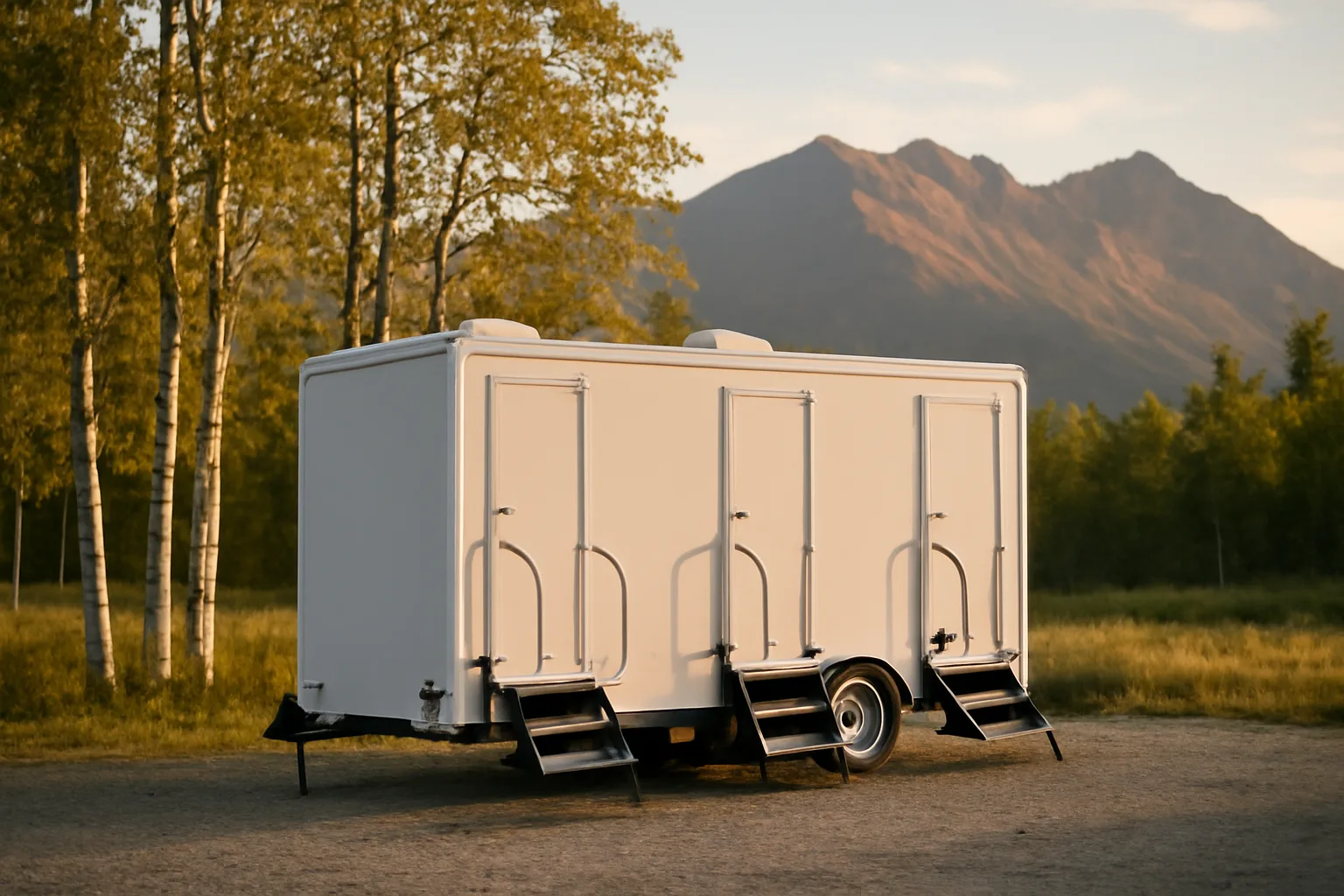
TL;DR
Alaska does not issue a luxury restroom trailer license. It requires a $50 state business license, local permits, and lawful wastewater disposal. Buy-in runs $25,000 to $90,000 for the trailer plus $3,000 to $9,000 for Alaska shipping. Expect 10 to 15 business days for the state license after a complete application, with no official guarantee. Rural and winter sites add water, heat, and dump-station planning.
Do you need a license for a luxury restroom trailer in Alaska?
You need a state Alaska business license before you take a deposit. There is no separate luxury restroom trailer license, portable restroom license, or toilet trailer certificate. The controlling statute is AS 43.70.020, which requires a license for most business activity in the state [1][2]. A local permit may also apply in Anchorage, Fairbanks, Juneau, or your borough, and wastewater disposal runs through the Alaska Department of Environmental Conservation [4]. For a state-only view with less cost talk, the luxury restroom trailer license in alaska walkthrough covers the same documents.
Here is what that means in practice. You file one business license application with the Division of Corporations, Business and Professional Licensing in the Department of Commerce, Community, and Economic Development. You pay $50 for one year or $100 for two years [1]. You renew every year unless you prepaid two. There is no board exam, no state inspection of your trailer as a condition of licensing, and no Alaska-specific plumbing board sign-off for renting a self-contained trailer.
Do not confuse the state license with a local privilege license. Some boroughs and cities issue their own. Check the clerk's office where you park the trailer and where you deliver. If you set up on public property, add a right-of-way or special event permit. Those are local documents, not state ones. A local permit can be the difference between a paid event and a code enforcement call.
How much does a luxury restroom trailer cost in Alaska?
Plan for $25,000 to $90,000 for the trailer itself. That range comes from national manufacturer listings, not an Alaska government index, so treat it as a planning number [7]. A basic 2-stall trailer with heat and running water often lands near $25,000 to $35,000. A 4-stall unit with AC, upscale finishes, and a wheelchair-accessible suite can reach $75,000 or more. Shipping from the lower 48 commonly adds $3,000 to $9,000 depending on origin, barge routing, and fuel.
Used trailers exist. Alaska cold and road salt punish cheap frames. I would rather buy a well-insulated 3-stall unit around $40,000 and spend the rest on a generator and a heated water supply than grab a $15,000 Facebook Marketplace trailer with frozen tanks. Nobody publishes clean used-trailer data; local rental companies sometimes sell fleet units in spring.
First-year operating costs get their own section below, but budget $10,000 to $25,000 more for insurance, maintenance, disposal, marketing, and licensing. Some operators wait until two events cover the payments. That works until a septic pump fails at 10 below zero. If the Alaska numbers make you wonder whether another state runs cheaper, the luxury restroom trailer cost in Vermont guide shows a different weather and shipping mix.
How long does a luxury restroom trailer take in Alaska?
The state business license commonly takes 10 to 15 business days after the Division receives a complete application, based on the state's posted processing guidance [1]. Alaska does not guarantee a fixed date, so apply online early. An urgent job is a bad reason to skip the license. If you file paper by mail from a rural community, add mail time both directions.
On-site setup takes 30 to 90 minutes once the trailer is level and water and power are connected. Cold-weather setup takes longer because you need a heated water hose, an antifreeze plan, and a place to drain. Loading, towing, and barge scheduling for bush communities can add days or weeks.
Think of it as two clocks. One runs 10 to 15 business days for the license. The other runs one to three hours on event day for a simple, already-plumbed site. If someone tells you the permit can wait, do not believe it. The licensing clock only starts when the application is complete, so a typo in the business name or NAICS code buys you another round.
Which state agency governs luxury restroom trailer operators in Alaska?
Three state agencies touch the work, and none of them calls it luxury restroom trailer licensing. The Alaska Department of Commerce, Community, and Economic Development issues the business license and keeps the corporate records [1]. The Alaska Department of Environmental Conservation regulates wastewater disposal [4]. The Alaska DMV, inside the Department of Administration, registers tow vehicles and trailers used on public roads [6].
For most operators, Commerce is the first and biggest stop. DEC matters when you pump a tank or use a dump station. DMV matters every time the rig moves on a public road. Municipal clerks matter when you set up on city or borough land. Treat this as a four-party document stack, not a single certificate. Operators coming from the lower 48 often assume a state bathroom license exists. It does not. To compare the same question in warmer states, see how to start luxury restroom trailer in alabama or how to start luxury restroom trailer in california, where the state plumbing boards sit in different places.
How do you get an Alaska business license for a restroom trailer?
Start online at the Division of Corporations, Business and Professional Licensing. Give your legal name or entity name, a physical Alaska address, a mailing address, and your NAICS code. Restroom trailer rental often fits under NAICS 562991, Septic Tank and Related Services, or 532310, General Rental Centers, depending on how you describe the work. Pick one. Do not stress about it. The Division uses the code for statistics, not for a separate exam.
Pay $50 for one year or $100 for two [1]. You can operate as a sole proprietor or form an LLC first. Alaska LLC Articles of Organization cost $250 [3]. If you form an entity, get an IRS EIN before you apply. It is free [9]. Most banks will not open a business account in the company name without one.
Do not use your home address on public filings if you want it kept private. Alaska business records are public. A registered agent or a commercial mailbox can keep your home address off the main filing, but the Division still needs a physical location where the business can be reached. That location can be your home. It does not need to be a commercial yard.
What local permits and zoning rules apply in Alaska?
Alaska has no single local permit. Anchorage, Fairbanks, Juneau, the Matanuska-Susitna Borough, and smaller home-rule cities run their own business license, zoning, and event permit forms. Check three things with the clerk or planning office: can you park a commercial trailer on the property, do you need a transient vendor or mobile business license, and what does a special event permit require for portable sanitation.
Some boroughs will call a luxury restroom trailer plain portable toilet service, and the local permit is cheap. Others treat it like a fixed commercial structure if you keep it parked for more than a few days. Rural unorganized boroughs have less zoning, but not zero. Land status still matters.
Set up on state or federal land, such as an Alaska State Parks site or a National Park Service concession, and you may need a separate use permit or concession contract. Those timelines run months, not days. The SBA's Alaska district office can point you to local checklists, but it cannot approve a local permit for you [10].
How do wastewater and septic rules work in Alaska?
Self-contained trailers still have to dump somewhere. Alaska law and DEC rules require lawful disposal of wastewater. You cannot open a valve onto the ground. Under 18 AAC 72, wastewater disposal systems and disposal activities need authorization [4][5]. For a rental business, the clean path is an RV dump station, a licensed septage receiving facility, or a municipal wastewater plant that takes hauled waste. Keep a disposal log. If a client asks you to discharge onto their property, say no unless they have a DEC-approved system and you know the permit allows it.
If you pump or haul the waste yourself, check whether DEC requires certification for septage haulers. The state regulates septage pumper and hauler activity. Carry a spill kit and a cold-weather plan, because a frozen black tank or dump valve can turn a wedding into a cleanup. Some operators skip hauling entirely and have a disposal vendor pump the trailer on site after the event. That costs more and cuts your equipment and compliance exposure.
OSHA's construction sanitation standard is blunt. It reads, "The employer shall provide adequate and readily accessible sanitation facilities" [8]. Event clients do not care about the statute. Venue managers sometimes do.
What tow vehicle, trailer registration, and driver rules apply in Alaska?
Alaska DMV requires registration for trailers operated on public roads, and the tow vehicle combination carries weight and brake rules [6]. A loaded 3-stall luxury restroom trailer can weigh 8,000 to 12,000 pounds before water. That usually puts you in a 3/4-ton or larger truck, not a half-ton. Electric trailer brakes and a weight-distributing hitch are the practical minimum.
Check whether you need a commercial driver's license. Federal CDL thresholds hinge on gross combination weight rating, not how fancy the trailer is. Many restroom trailer operators stay under 26,001 pounds GCWR and skip the CDL, but a large unit plus a service truck can push the total over [11]. If you cross state lines or operate for hire in a commercial vehicle, motor carrier and USDOT number rules can apply. Confirm with Alaska DMV and the Federal Motor Carrier Safety Administration before you buy the tow rig. Put the trailer on a scale, not a forum guess. The same weight logic applies in arizona, where the trailer weighs exactly what it weighs here.
What insurance should a luxury restroom trailer operator carry in Alaska?
Commercial auto is the first line. A personal auto policy will likely deny a claim once the truck and trailer are used for rental work. General liability covers a guest slipping on trailer steps or a bad septic leak at the venue. Inland marine or trailer physical damage covers the unit itself, including water damage from frozen lines. Pollution liability earns a real look, because a waste spill at an Alaska wedding site is expensive to clean, and local landowners do not forget.
Shop this as an Alaska-specific risk, not a generic small business policy. Some underwriters price luxury restroom trailers like carnival equipment, which raises theft and winter freeze claims. Ask a local agent who writes contractors and event vendors. Expect $1,500 to $5,000 per year for a small operation depending on coverage and driving record. That is a planning range, not a quote. Require proof of event insurance from some venue clients, and name them as additional insured when the contract says so.
What does a realistic first-year budget look like in Alaska?
No single spreadsheet fits every Alaska operator. Buy a mid-range trailer around $40,000, ship it for $5,000, and run it yourself, and a lean first year can look like the table below. High-end units, hired drivers, a shop, or a heated storage building push the number past $100,000 fast.
| Cost item | Realistic range |
|---|---|
| Trailer purchase | $25,000 - $90,000 |
| Alaska shipping | $3,000 - $9,000 |
| Business license, LLC, EIN | $50 - $300 |
| Commercial auto and liability insurance | $1,500 - $5,000 per year |
| Waste disposal, maintenance, winter prep | $3,000 - $8,000 per year |
| Marketing and website | $1,000 - $4,000 per year |
These are working ranges from industry price data and operator defaults, not state fee schedules. Confirm the small state fees exactly. The variable costs run wider than most first-time owners expect. The budget makes one point clear: the trailer purchase is not the whole spend. LuxJohnPath sells a $199 one-time Wedding Trailer Spec Kit if you want a done-for-you equipment list, but the Alaska paperwork and disposal plan still sit on you.
What should you charge for Alaska luxury restroom trailer rentals?
Alaska event toilets are not Seattle event toilets. Transportation, cold-weather readiness, and dump access push rates up. A basic 2-stall luxury unit often rents for $800 to $1,500 per event day in Southcentral Alaska. A 4-stall or ADA trailer can run $1,500 to $3,500 per day depending on season and distance. Price wedding packages with delivery, water, power, attendant service, and next-day pickup as one complete service, not a per-stall line item.
I would not charge less than $1,000 per event day in Anchorage for a clean, heated trailer with fresh water and a real grey/black tank plan. Be the low bidder in Kenai or Fairbanks and you will lose money on the first frozen line. Charge a winter surcharge and a mileage fee outside a 50-mile radius. Remote sites need enough margin to cover barge or air freight for parts when something cracks.
What cold-weather and rural logistics matter in Alaska?
Cold changes the business. Water lines freeze, tanks freeze, dump valves freeze, and hand sanitizer gels at low temperatures. In winter, run a heated water hose, insulate the underbelly, keep the heat on during standby, and use RV antifreeze in the freshwater system if the manufacturer allows it. Never put automotive antifreeze in a drinking water line. Carry a spare water pump, hose washers, and a heat gun. Park the trailer outside and a block heater on a generator can hold the interior above freezing.
Rural Alaska adds another layer. Communities off the road system mean barge, cargo plane, or seasonal ice road delivery. That stretches maintenance parts and fuel lead times to weeks. A simple pump failure in Nome is not a same-day Amazon fix. Build a parts kit before you take a remote booking. Some operators serve only road-connected areas for the first two years and add bush work once they have a local fixer and a warm storage plan. That is not fear. That is Alaska math.
If your plan bends toward a warmer start, the how to start luxury restroom trailer in arizona and how to start luxury restroom trailer in colorado guides show different market shapes. Once the state and local paper is in hand, a $199 Wedding Trailer Spec Kit from LuxJohnPath can work as an ordering checklist, but it replaces none of the Alaska filings above.
Frequently asked questions
Do you need a license for a luxury restroom trailer in Alaska?
Yes. Alaska requires a state business license under AS 43.70.020 before you operate. There is no separate luxury restroom trailer license [1]. You may also need a local borough or city business license, a right-of-way permit for public setups, and lawful wastewater disposal through an approved dump station or facility [4].
How much does a luxury restroom trailer cost in Alaska?
New units often run $25,000 to $90,000, with shipping to Alaska adding $3,000 to $9,000 [7]. A basic 2-stall heated unit sits near $25,000 to $35,000. A 4-stall ADA trailer can hit $75,000 or more. Add $10,000 to $25,000 for first-year operations.
How long does a luxury restroom trailer take in Alaska?
The state license commonly takes 10 to 15 business days after a complete application, with no formal guarantee [1]. Setup at a prepared site takes 30 to 90 minutes. Remote bush shipping and local permit review can add days or weeks, so plan separate clocks.
Can I operate as a sole proprietor in Alaska?
Yes. You can use your own name or register a DBA. An LLC is not required to rent trailers. If you choose an LLC, Alaska charges $250 for Articles of Organization [3]. Sole proprietors still need the state business license and an EIN if they have employees or want entity-style banking.
What insurance do I need for a luxury restroom trailer in Alaska?
Commercial auto, general liability, and physical damage on the trailer are the core. Pollution liability matters because a sewage spill is expensive to clean. Shop with an agent who writes contractors and event vendors. Budget $1,500 to $5,000 per year for a small operation.
Do I need a CDL to pull a luxury restroom trailer in Alaska?
Not automatically. CDL rules hinge on gross combination weight rating, tires, brakes, and for-hire operation. Many operators stay under 26,001 pounds and skip the CDL, but a large loaded trailer and service truck can cross the line [11]. Confirm with the FMCSA and Alaska DMV.
Where do I dump the waste from an Alaska restroom trailer?
Use an RV dump station, a licensed septage receiving facility, or a municipal wastewater plant that accepts hauled waste. Do not discharge onto the ground. DEC regulates wastewater disposal under 18 AAC 72 [4][5]. Keep disposal logs. A frozen tank can ruin an event, so plan winter dump timing.
Do I need an Alaska DEC permit to rent restroom trailers?
Maybe, depending on how you handle waste. Renting a self-contained trailer does not by itself require a DEC permit. Pumping or hauling septage may require certification. If you discharge anywhere other than an approved facility, you need authorization [4][5]. Confirm with DEC before you start.
Does Alaska have a state sales tax?
Alaska has no state sales tax. Some boroughs and cities levy local sales taxes. Check the local tax division or clerk where the trailer is delivered and where your business is located. Do not assume an event price is tax-free just because the state has no sales tax.
How much does it cost to register a trailer in Alaska?
Alaska trailer registration fees depend on weight and type. The DMV registration page has the current fee table [6]. Keep the trailer registered at the correct weight, because an understated weight can become a fine if you get inspected. Confirm with DMV; fees change.
Can I rent a luxury restroom trailer in Alaska winter?
Yes, if the trailer is heated and you control water. Use a heated water hose, keep the interior heat on, protect tanks, and carry RV antifreeze meant for potable systems. Winter rentals command a surcharge. Without a heated storage plan, freeze damage will eat your margin.
Is a restroom trailer a commercial vehicle in Alaska?
Sometimes. If it is used for hire, the combination weight and interstate movement will decide. A one-ton truck and a 12,000-pound trailer can push toward commercial registration and insurance. Check with Alaska DMV and the FMCSA before buying the rig [6][11].
Sources
- Alaska Department of Commerce, Community, and Economic Development, Division of Corporations, Business and Professional Licensing - Business Licensing: State business license required, fee $50 per year or $100 for two years, processing about 10 business days.
- Alaska Statutes AS 43.70.020 - License required: A person may not conduct business in Alaska without a business license.
- Alaska Division of Corporations, Business and Professional Licensing - Forms and Fees: Alaska LLC Articles of Organization filing fee is $250.
- Alaska Department of Environmental Conservation, Division of Water - Wastewater Disposal: Wastewater disposal requires authorization; hauled waste must go to approved disposal sites or facilities.
- Alaska Administrative Code 18 AAC 72.020 - Wastewater disposal authorization: Disposal of wastewater requires authorization from the department.
- Alaska Department of Administration, Division of Motor Vehicles - Vehicle Registration: Trailers operated on public roads require registration; fees depend on weight and type.
- Occupational Safety and Health Administration - 29 CFR 1926.51 Sanitation: Employer shall provide adequate and readily accessible sanitation facilities.
- Internal Revenue Service - Employer ID Numbers: Most business entities need an EIN before opening bank accounts or filing returns.
- U.S. Small Business Administration - Alaska District Office: SBA Alaska district office provides local business startup checklists and counseling.
- Federal Motor Carrier Safety Administration - Commercial Driver's License: CDL is required for certain commercial motor vehicles, including combination vehicles over 26,001 pounds GCWR.