Last updated 2026-08-18
TL;DR
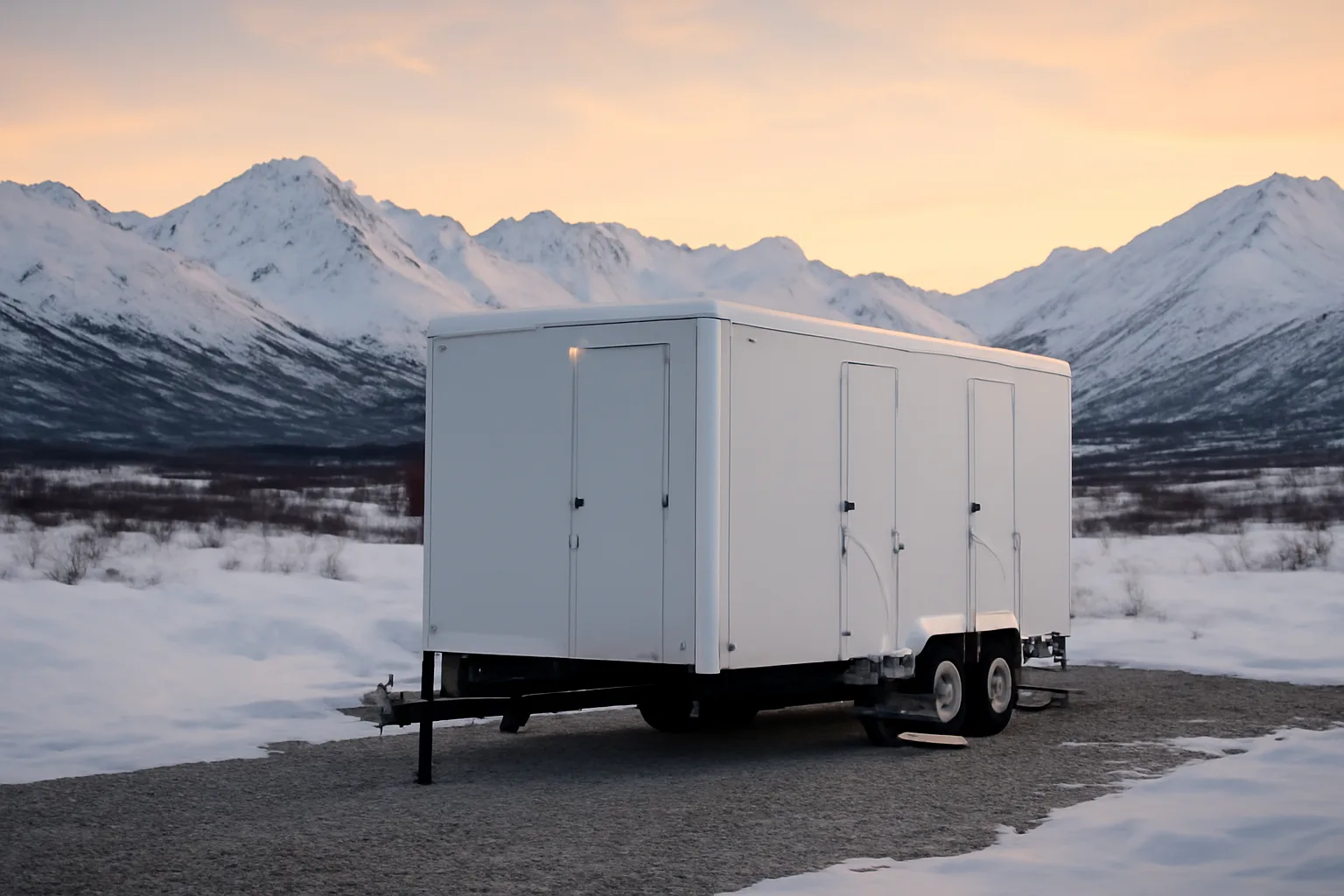
A new, Alaska-ready luxury restroom trailer costs $35,000 to $120,000 or more, depending on stall count and cold-weather gear. Alaska charges a $50 annual business license [1], and waste haulers need a DEC permit [3]. Ordering and delivery take 3 to 6 months. Barge or truck freight adds $2,500 to $7,000, winterization runs $4,000 to $8,000, and first-year insurance is roughly $2,000 [6].
What does a luxury restroom trailer cost in Alaska?
A delivered 2-stall luxury restroom trailer with a basic cold-weather package costs $35,000 to $50,000 in Anchorage. A 4-stall in the same trim runs $60,000 to $85,000. An 8-stall unit for big events lands at $120,000 or more. Every one of those totals stacks three things: the manufacturer's base price, freight to Alaska, and the winterization that keeps tanks and water lines from freezing.
Base prices from a major manufacturer like JAG Mobile Solutions start around $31,900 for a 2-stall Escape, $58,900 for a 4-stall Oasis, and $109,900 for an 8-stall Summit, before tax and shipping [6]. That hardware is built to Lower 48 standards. Alaska asks for more.
Freight is the first jump. Trucking or barging a trailer from a Seattle-area plant to Anchorage costs $2,500 to $5,000, depending on size and fuel surcharges. Barge to Juneau or Sitka can hit $4,500. Fairbanks means trucking the last leg up the Parks Highway, which adds mileage fees. A trailer bound for a remote North Slope camp might cost $7,000 or more in freight, and you wait on weather windows.
Then the cold-weather tax hits. A real Alaska winterization package (insulated and heat-traced holding tanks, arctic-grade windows, a furnace upgrade, battery warmers) runs $4,000 to $8,000 from a specialty upfitter. Skip it and you own a $40,000 paperweight from October to April. So the honest delivered price for a small operation is about $40,000 for a 2-stall, $70,000 for a 4-stall, and north of $125,000 for an 8-stall with the full arctic kit.
Why Alaska costs more: shipping, winterization, and remote logistics
The gap between a Lower 48 sticker and a real Alaska invoice is wide. Most manufacturers sit in the Midwest or on the West Coast, and freight north is a specialized route, not a UPS run. Trailers move by barge from Seattle to Anchorage, Whittier, or Southeast ports, or by truck up the Alaska Highway. Lynden, a carrier that runs Alaska daily, prices a 20-foot enclosed trailer from Seattle to Anchorage at roughly $3,000 to $5,000 depending on season and commodity [7]. You pay for length and weight both.
Winterization is not optional. A luxury trailer carries freshwater and waste tanks slung underneath, exposed to road spray and subzero air. Interior Alaska sees minus 40 regularly. Manufacturers sell "arctic packages" with dual-pane thermal windows, insulated underbellies, 12-volt tank heaters, and upgraded propane or diesel furnaces. Some add block-style heaters for the onboard generator. All of it bumps the price 15 to 25 percent over base.
Remote sites bring their own bill. Run a trailer at a wedding near Healy or a mining camp outside Nome and you need a service truck to haul fresh water and pump out waste. Some operators budget $200 to $400 per service run just for fuel and wear. No shore power means a generator and a fuel cache. Every one of these costs sits on top of the trailer.
Do you need a license for a luxury restroom trailer in Alaska?
Yes. At a minimum, you need a State of Alaska business license. Alaska Statute AS 43.70.020 requires every person engaging in business to hold one [2]. The fee is $50 a year for most small businesses, paid online through the Division of Corporations, Business and Professional Licensing [1]. Run the trailer as a sole proprietor with one business location, and a single license covers you.
Hauling and dumping wastewater pulls you under the Department of Environmental Conservation. Alaska Administrative Code 18 AAC 72 governs waste haulers, and DEC requires a permit for vehicles that transport septic tank contents or portable toilet waste [3]. The permit is called a Septage and Portable Toilet Waste Transporter Permit. The fee changes over time, so confirm the current number with the DEC Division of Water before you budget [3].
Local governments add their own layers. The Municipality of Anchorage often wants a local business license too, plus special event permits when the trailer sits on public property. In unorganized boroughs, state law is the only authority, but call the nearest city clerk anyway. Self-contained trailers that connect to no outside plumbing usually don't trigger a state plumbing permit under the adopted Uniform Plumbing Code [5]. Hook into a venue's water or sewer, though, and a mechanical permit from the Department of Labor or a local plumbing inspector can come into play. Most operators dodge it by staying fully self-contained.
How long does it take to get started with a luxury restroom trailer in Alaska?
The Alaska business license application is online and quick. The Division of Corporations says "most business licenses are issued within 10-15 business days of receipt of a complete application" [1]. File online, pay the $50, and you usually have a license number in two to three weeks.
DEC permitting takes longer. Processing for the septage and portable toilet waste transporter permit swings widely, and the department suggests allowing 30 to 90 days for review and issuance [3]. Incomplete applications stretch that further. You submit vehicle descriptions, disposal sites, and proof of insurance.
The trailer is its own clock. Custom orders run 6 to 12 weeks in fabrication. Ground and barge shipping from the Lower 48 adds 2 to 3 weeks. A local upfitter installing the arctic package wants another 2 to 4 weeks. From order to first tow, plan on 12 to 24 weeks. Call it 3 to 6 months. Buy a pre-built unit already in state and you move faster.
What ongoing costs should I budget for in Alaska?
A luxury restroom trailer is a depreciating asset, not a passive income machine. Annual insurance for liability and physical damage on a $60,000 trailer runs $1,500 to $2,500. Tow it with a truck and commercial auto insurance adds $1,200 to $2,000. Workers' compensation is required under Alaska Statute AS 23.30.045 the moment you have employees [4]. Sole proprietors can opt out for themselves, but any helper is covered.
Dumping waste costs money. Municipal treatment plants often charge $20 to $50 per 1,000 gallons. A fully used 4-stall trailer can produce 200 to 300 gallons per event. Mobile pump-out services in Anchorage and Fairbanks charge $150 to $400 per call. Work remote sites and you either own a pumper truck or contract with someone who does.
Maintenance never stops. Alaskan roads punish trailers, and freeze-thaw cycles punish plumbing. Budget $1,000 to $3,000 a year for repairs, winter prep, and consumables like RV antifreeze, tank chemicals, and replacement hoses. Winter storage adds more: indoor heated storage runs $100 to $300 a month in population centers, and it is the cheapest insurance against freeze damage during idle months.
Winter operation: what you need to know
Alaska's cold breaks a standard luxury trailer inside a season. The upgrades that matter are insulated tanks with 12-volt heating pads, a heated freshwater hose (or an internal freshwater tank), and a furnace that holds 68 degrees inside when it is minus 30 outside. Wall plumbing has to sit in heated chases or wrapped in heat tape. Many operators add a small diesel parking heater that runs on its own, apart from the main generator, and saves fuel.
Even then, run antifreeze through the system anytime the trailer sits more than a day without heat. Keep a log. At minus 20, an unoccupied trailer can freeze solid in three hours if wind strips the belly heat. A kit like LuxJohnPath's $199 Wedding Trailer Spec Kit helps you pick the right insulation and tank-heater setup from the start, but the actual install belongs to a shop that works Alaskan RVs year-round.
Snow load is a structural problem. A 4-stall trailer's flat roof can collect 500 pounds of snow in one storm. Park it under cover or plan to shovel. High wind in the Matanuska Valley or on the Kenai can flip a light trailer, so anchor it to the ground every time.
Buying vs. renting: which makes sense in Alaska?
Produce events in Alaska year-round and buying a luxury restroom trailer pencils out. At roughly $800 a day for a 2-stall and $1,200 for a 4-stall, 50 event days recover a $40,000 purchase in one season, before operating costs. You also control the condition, which matters when a rental shows up with a dead heater.
Need a trailer for one or two weddings a summer? Rent. Firms like Alaska Portable Toilets in Anchorage and Fairbanks rent luxury restroom trailers by the day, weekend, or week. Remote delivery costs a premium. The real catch is availability: in June and July, trailers book out months ahead.
Rental prices in Alaska sit above the national average because they carry the same shipping, maintenance, and insurance load. A 4-stall trailer with a private suite can rent for $1,500 to $2,000 per weekend on the Kenai Peninsula, delivered. For a one-time wedding, that still beats a purchase by a wide margin.
Where to find luxury restroom trailers that deliver to Alaska
Several manufacturers ship directly to Alaska or work through dealers in Anchorage and Wasilla. JAG Mobile Solutions (based in the Midwest) and Satellite Industries (nationwide) build luxury trailers with arctic options. Local RV dealers sometimes stock entry-level units, but custom orders are normal. When you order, state plainly that the trailer heads to Alaska, because the carrier has to strap it for highway and barge travel.
Used trailers surface on Alaska List or Facebook Marketplace, often from event companies that traded up. Inspect a used unit hard for freeze damage. Pull every access panel. Check for cracked holding tanks and burst PEX lines. A clean used 4-stall might run $35,000 to $50,000 in state, a real discount over new, but you can inherit someone else's skipped winter maintenance.
What insurance do you need in Alaska?
Commercial general liability is the floor. Most venues and municipalities want $1 million per occurrence, often with a $2 million aggregate. It covers injury claims from slips, falls, or carbon monoxide incidents. Premiums run $1,500 to $2,500 a year.
Inland marine insurance (an equipment floater) covers the trailer and its contents in transit and on site. This is not auto insurance. It is property insurance on wheels. A $60,000 trailer might cost $800 to $1,200 a year for inland marine coverage with a $500 deductible.
Buy a truck to tow the trailer and Alaska requires commercial auto insurance. State minimums are low ($50,000/$100,000 liability), but any lender or sensible operator carries $500,000 combined single limit or more. Workers' comp is mandatory for employees under AS 23.30.045 [4]. The National Council on Compensation Insurance class code for portable toilet rental (9521) drives the rate, and premiums swing with payroll.
Quick steps to get your luxury restroom trailer business running in Alaska
Start with the business license through the Division of Corporations website. Pay the $50 [1]. Next, call DEC's Division of Water to find out whether you need a septage and portable toilet waste transporter permit, then pull the application and list your planned disposal sites. Third, order the trailer with a written arctic package spec and confirm the full shipping routing (manufacturer to carrier, barge line, final delivery). Fourth, lock down storage with at least a roof, ideally a heated space. Fifth, bind insurance before the trailer ships. Sixth, secure a waste disposal site. Municipal plants in Anchorage, Fairbanks, and Juneau take trailer waste; in rural areas you may need an approved lagoon or composting site. For a full Alaska startup checklist, visit /start.
Frequently asked questions
Do you need a license for luxury restroom trailer in Alaska?
Yes. Alaska requires a business license under AS 43.70.020 for any commercial activity. If you transport or dispose of wastewater from the trailer, you also need a septage and portable toilet waste transporter permit from the Department of Environmental Conservation. Some municipalities add local business licenses and event permits on top of the state requirements.
How much does luxury restroom trailer cost in Alaska?
A delivered 2-stall luxury trailer with cold-weather upgrades runs $35,000 to $50,000. A 4-stall ranges $60,000 to $85,000, and an 8-stall can top $120,000. Those figures fold in the manufacturer base price, shipping to Alaska ($2,500 to $7,000), and winterization work ($4,000 to $8,000).
How long does luxury restroom trailer take in Alaska?
Allow 3 to 6 months from order to first booking. The business license takes 10 to 15 business days, a DEC waste transporter permit can run 30 to 90 days, and custom fabrication usually needs 6 to 12 weeks. Shipping from the Lower 48 adds another 2 to 3 weeks.
What permits do I need for a luxury restroom trailer on public land in Alaska?
Place the trailer on state land or municipal property for an event and you need a land use permit from the managing agency. Examples include a Temporary Use Permit from the Alaska Department of Natural Resources or a special event permit from a borough. Requirements shift by location and duration, so ask the local permitting office first.
Can I use a luxury restroom trailer in winter in Alaska?
Yes, but only with a full winterization package. Insulated and heated tanks, a furnace that holds interior temperature at minus 30 outside, and a heated freshwater system are all mandatory. Without them, the trailer freezes in a few hours. Indoor heated storage between uses is strongly recommended.
Do luxury restroom trailers need to meet Alaska plumbing code?
Self-contained trailers that never connect to a public water or sewer system usually fall outside the state plumbing code. Hook the trailer into external plumbing at a venue, though, and a mechanical permit and inspection by the Alaska Department of Labor or a local official may apply. The state adopts the Uniform Plumbing Code by reference.
How much is a business license in Alaska for a restroom trailer business?
The annual business license fee is $50 for most small businesses, paid to the Division of Corporations, Business and Professional Licensing. There is no extra state fee tied to employee count if you have fewer than 100 employees. Renewal is also $50 per year.
What insurance do I need for a luxury restroom trailer rental business in Alaska?
Commercial general liability (minimum $1 million per occurrence) is standard. Inland marine insurance covers the trailer and its contents. Tow with a vehicle and commercial auto insurance is required. Workers' compensation is mandatory under AS 23.30.045 for any employee, though sole proprietors can waive coverage for themselves.
How do I dispose of waste from the trailer in remote Alaska?
Municipal treatment plants in towns like Anchorage, Fairbanks, and Juneau take trailer waste, usually for a fee per 1,000 gallons. In remote areas, you may need an approved sewage lagoon or a permitted composting site. Coordinate the disposal location with DEC before you operate.
Is a CDL required to tow a luxury restroom trailer in Alaska?
Usually not. Most luxury restroom trailers carry a gross vehicle weight rating under 10,000 pounds, below the federal CDL threshold when towed by a non-commercial vehicle. If the combination tops 26,001 pounds or you run for-hire, a CDL may apply. Check Alaska's commercial motor vehicle guide for your exact setup.
Sources
- Alaska Division of Corporations, Business and Professional Licensing - Business Licensing FAQs: Annual business license fee is $50 for most businesses; most licenses issued within 10-15 business days.
- Alaska Statutes AS 43.70.020: Requires a business license for any person engaging in business in the state.
- Alaska Department of Environmental Conservation - Portable Toilets and Holding Tanks: Waste transporter permit required for vehicles hauling portable toilet waste; permit application and fee set by DEC.
- Alaska Statutes AS 23.30.045: Workers' compensation insurance is mandatory for employers with one or more employees.
- Alaska Department of Labor and Workforce Development - Mechanical Inspection Section: Alaska adopts the Uniform Plumbing Code by reference; plumbing permits may be required for permanent connections.
- JAG Mobile Solutions - Luxury Restroom Trailers: Base price for 2-stall Escape model $31,900, 4-stall Oasis $58,900, 8-stall Summit $109,900.
- Lynden - Shipping to Alaska: Freight from Seattle to Anchorage for a 20-foot trailer typically ranges $3,000-$5,000 depending on season and dimensions.