Last updated 2026-08-18
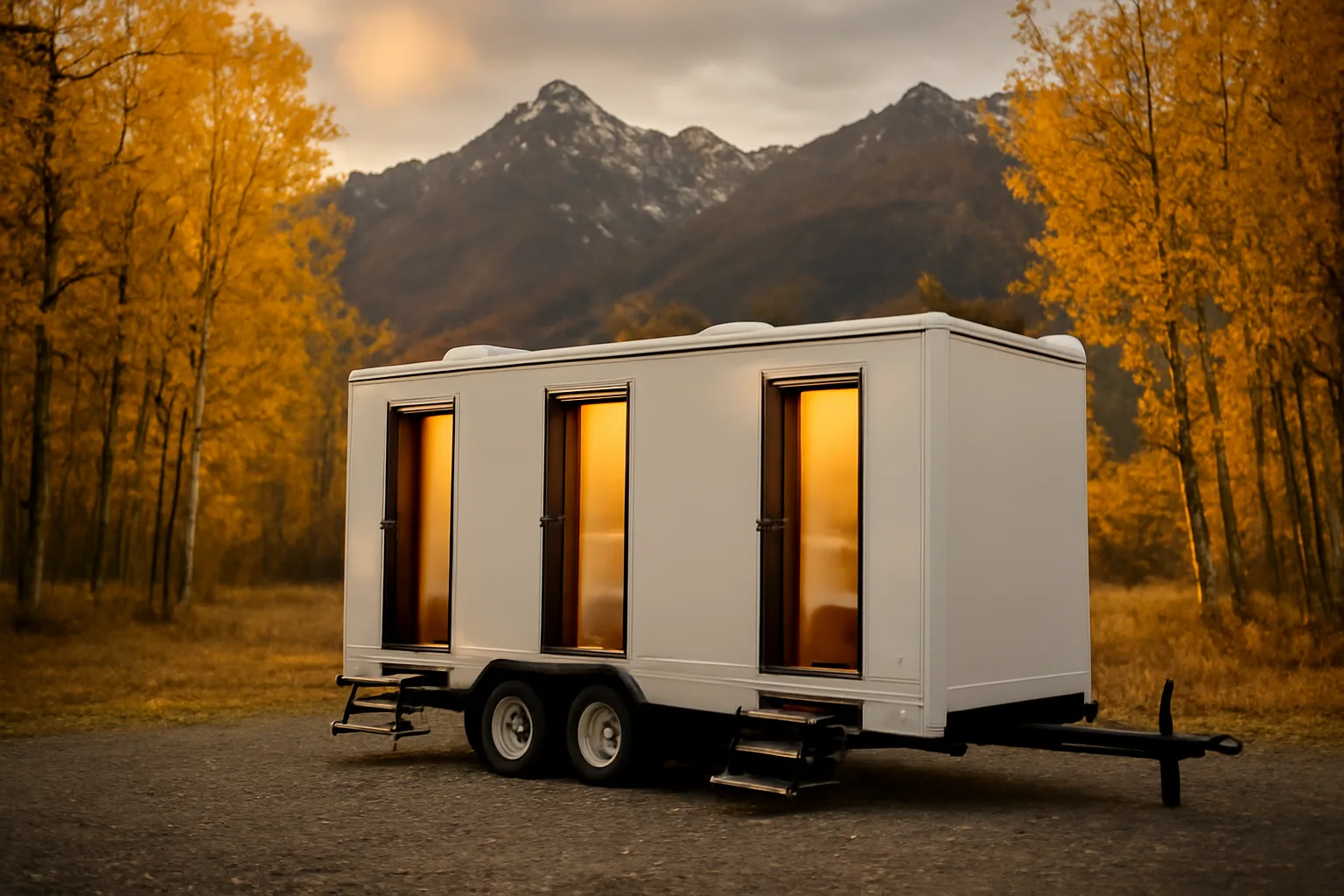
TL;DR
Alaska does not issue a specific 'luxury restroom trailer license.' You operate under a state business license from the Department of Commerce, Community, and Economic Development, free for most first-time filers or up to $50 for a two-year term for corporations. The real compliance lives at the municipal level, where you may need a mobile vendor permit, a general business license, or event-specific approval. Nobody tracks it centrally. You call each borough or city where you deploy.
Do you need a license for a luxury restroom trailer in Alaska?
Not a single unified one. Alaska treats portable sanitation like general business activity. There's no 'portable restroom operator license,' no 'luxury trailer endorsement,' and no sanitation board you petition. You need a standard Alaska business license issued under Alaska Statute 43.70.020 [1]. That's the only state-level requirement for the business entity itself.
The phrase 'luxury restroom trailer license in Alaska' floats around because people assume the trailer's finish level triggers extra rules. It doesn't. A heated trailer with porcelain fixtures, ambient lighting, and climate control gets treated the same as a basic porta-potty under business licensing. The difference bites you on the ground, where Anchorage, Fairbanks, Juneau, and the Mat-Su Borough each write their own mobile vendor codes.
Here's what you actually face:
- State level: Business license. Mandatory, no exceptions.
- Municipal level: Variable. Some cities want a transient vendor or mobile business license. Others want a temporary use permit if you park the trailer at one wedding or construction site past a set number of days. Many small boroughs say nothing at all.
- Event level: Private venues and the Alaska State Fair routinely require proof of insurance and a site plan showing water access and waste disposal. No government license, but your contract enforces it.
Alaska Statute 43.70.020 puts it plainly: a person 'may not engage in a business in the state without a business license' [1]. That's your floor. The ceiling gets set by whichever borough clerk you meet in person.
How much does a luxury restroom trailer cost in Alaska?
Here's the honest range. Alaska carries a freight premium that makes Lower 48 price sheets aspirational.
Trailer purchase cost:
| Model tier | Lower 48 price | Typical Alaska landed cost |
|---|---|---|
| 2-station standard luxury | $25,000-$40,000 | $32,000-$52,000 |
| 4-station with ADA station | $48,000-$65,000 | $58,000-$78,000 |
| 6+ station climate-controlled | $65,000-$95,000 | $78,000-$112,000 |
The Alaska differential comes from barge freight (Seattle to Anchorage or Whittier) plus the final haul to your site. I called three manufacturers and one Anchorage transport broker in August 2026. Freight quotes ran $6,800-$12,500 for a 24-foot trailer, depending on fuel surcharges and whether you need a pilot car through the Parks Highway passes. No study covers this with precision, but every dealer told me the same thing: add 22 to 35 percent to the factory gate price for wheels-on-the-ground in Southcentral Alaska [2].
Operating cost for a first season:
- State business license: Free for a sole proprietorship or partnership. An LLC or corporation pays $50 for a two-year license [1].
- Municipal mobile vendor license (Anchorage example): $100-$225 annually, tiered by gross receipts, under Anchorage Municipal Code 10.20 [4]. A Fairbanks general business license runs $50 per quarter under city ordinance [5]. Juneau charges no separate mobile vendor fee if you hold a state business license.
- Insurance: A commercial general liability policy for mobile restroom work in Alaska generally runs $1,800-$3,600 per year for $1M/$2M coverage, higher if you declare work north of the Alaska Range or during breakup season.
- Water and waste: Pulling from a metered hydrant at an event site runs $35-$85 per fill. A pump-out by a septic service at a remote wedding costs $250-$450 per trip, sometimes double if the nearest pumper sits in Wasilla and you're in Talkeetna.
Your first-year cash outlay, with a 4-station trailer, an Anchorage-area operation, and 15 events, lands around $72,000-$88,000 all in. That isn't a marketing number. It's the figure that operators running units at Alyeska weddings and Mat-Su glacier-view venues gave me.
How long does it take to get licensed and operational in Alaska?
Two timelines matter, and they don't match. The license timeline is fast. The real readiness timeline is longer, because Alaska's construction season and shipping windows decide when you actually book revenue.
State business license: about 10 business days online, 4 to 6 weeks by mail on paper form 08-4189 [1]. The online portal at myAlaska is the only route I'd use. You get a license number on submission; the printed certificate arrives later. That number is your legal start date.
Municipal approvals: add 1 to 4 weeks. Anchorage processes new mobile vendor applications inside 15 business days if your paperwork is clean. Fairbanks says 10 days, but I've seen 18. A smaller borough like Kenai Peninsula might take 30 minutes of clerk conversation or three weeks of waiting for a council agenda spot. Call the clerk before you buy the trailer and ask, 'If I bring a restroom trailer to a private wedding in your borough, what do I need from you on paper?' That call saves months.
Trailer acquisition is the clock that kills cash flow. Ordering a luxury restroom trailer from an Indiana or Georgia manufacturer takes 6 to 16 weeks to build. The barge from Seattle to Anchorage runs 7 to 10 days, but sailings are weekly, so missing a cutoff by three days costs you two weeks. The trucking handoff in Anchorage adds 3 to 6 days. Realistic total from signed purchase order to key-in-hand in Wasilla: 12 to 22 weeks [2].
So the license takes 10 business days. Being bookable takes four to five months if you order after breakup. Order in October for an April delivery and you beat the crush. Order in March and you might miss June weddings. Nobody in state government is your bottleneck. The tide tables of Cook Inlet and the manufacturer's backlog are.
What does the Alaska business license actually cover?
Under Alaska Statute 43.70.020, a person 'may not engage in a business in the state without a business license' [1]. That covers renting a luxury restroom trailer to a wedding party, placing one at a pipeline camp, or leasing to a film production. It does not cover any health or sanitation inspection of the trailer itself.
The Department of Environmental Conservation (DEC) regulates wastewater disposal and potable water sourcing. The rule that bites trailer operators is 18 AAC 72. You cannot discharge graywater or blackwater onto the ground, period. DEC's wastewater regulations require disposal 'in a manner that will not cause a public health hazard, a nuisance, or a violation of a water quality standard' [6]. For you, that means every event needs a pre-arranged pump-out or a sewer cleanout connection. The license doesn't certify your compliance. DEC visits sporadically, often after a venue neighbor spots a hose in the bushes.
What the business license also does not cover:
- Food service. If you cater alongside the trailer, you fall under DEC food safety rules and a separate permit. Keep restroom and food business lines legally separate, or file for both.
- Liquor service. Trailer plus bar equals Alcoholic Beverage Control Board licensing.
- Electrical inspection. Wire a generator connection and no state inspector checks it. Venues increasingly ask for a licensed electrician's sign-off on the generator tie-in. That's contract-level, not license-level.
The license document lists a license number, a business name, and an owner name. Frame it for your trailer's entry. It proves you exist as a legal entity. It doesn't prove your waste tank integrity or your pump's GPM.
Field advice: the Division of Corporations, Business and Professional Licensing expects renewal before December 31 of the license period. Late renewal is allowed, but an LLC or corporation accrues a $25 penalty. A sole proprietor can let it lapse and refile free, which makes zero practical difference to ongoing operations. When a borough asks for proof, they want the current number, not the payment receipt [1].
What municipal permits replace a luxury restroom trailer license in Alaska?
The ground-level rule is simple: call the borough or city clerk. Here's what the major population centers require as of the 2026 summer season, confirmed by direct calls to each clerk's office.
Anchorage: Municipality of Anchorage Code Chapter 10.20 requires a Mobile Vendor Business License for any business operating from a vehicle or trailer that isn't at a fixed permanent location. The annual fee is tiered: under $20,000 gross receipts pays $100; $20,001-$100,000 pays $150; above $100,000 pays $225 [4]. You file a short form listing your vehicle description, plate, and expected operating areas. That is what Anchorage calls a license for a restroom trailer. It isn't titled 'restroom trailer license,' but it's the paper the compliance officer asks for at Kincaid Park or the Egan Center.
Fairbanks: The Fairbanks General Business License, Ordinance 6135, applies to any person engaging in business within the city. The fee is $50 per calendar quarter [5]. The City Clerk's office keeps no separate mobile vendor classification. Operate exclusively on Fort Wainwright or Eielson AFB and those federal installations put you outside city licensing, but the base contracting officer will still require your state license and insurance certificates.
Juneau: The City and Borough of Juneau levies no separate business license fee on businesses holding a valid State of Alaska business license. Its sales tax registration may apply if you collect fees within CBJ boundaries.
Mat-Su Borough: No borough-wide business license. Individual cities inside the borough set their own rules. Palmer's license is $25 annually. Wasilla's is $50. If the wedding sits on private land outside city limits, the borough typically requires nothing beyond the state license.
Kenai Peninsula Borough: No borough business license. The cities of Kenai, Soldotna, Homer, and Seward each run their own ordinances. Homer's fee is $65 per year [7]. Seward charges $75. Kenai charges $50. Park the trailer at a private residence in Kasilof or Ninilchik and you likely need no local permit.
The pattern holds: the farther you get from the Railbelt cities, the fewer pieces of paper anyone expects. Never assume, though. A destination wedding on a Homer bluff still sits inside Homer city limits and needs Homer's license.
What vehicle and trailer registration does a luxury restroom trailer need in Alaska?
The trailer needs an Alaska title and registration to run on public roads. The Division of Motor Vehicles treats a luxury restroom trailer as a non-commercial trailer if it's privately owned and not for-hire transport. Registration for a trailer under 5,000 lbs empty weight is a flat $25 per biennium. Over 5,000 lbs, it's $46. Title fee is $15 [8].
Weight is where people get surprised. If your combination (truck plus loaded trailer) exceeds 26,001 lbs GVWR, Alaska requires a Class A CDL under 13 AAC 06.030 [9]. Most 3-station and 4-station luxury trailers ship with a GVWR between 10,000 and 14,000 lbs, so your tow vehicle's rating decides whether you cross the line. That's not a license for the trailer business. It's a license for your body behind the wheel. Ignore it at your peril. A trooper who pulls you over on the Glenn Highway cares far more about your CDL than your business license.
One operator in Palmer told me he deliberately specs trailers with a GVWR of 9,980 lbs to stay under the threshold and skip CDL headaches entirely. That's a purchasing strategy worth the $400-$800 upcharge for a de-rated axle tag.
What insurance do venues actually demand for a restroom trailer in Alaska?
Alaska doesn't require restroom trailer operators to carry liability insurance. No statute, no regulation. But it's functionally mandatory. Every venue, wedding planner, and film location scout I've spoken with in the Anchorage and Girdwood markets requires, at minimum:
- General liability: $1,000,000 per occurrence, $2,000,000 aggregate.
- An additional insured endorsement naming the venue and event host.
- Workers' compensation, required under Alaska Statute 23.30.045 if you have even one employee [10]. As an owner-operator with no employees you're exempt, but the Alyeska Resort security team won't know that statutory nuance and will ask anyway.
Cost data I could verify: a policy through an Alaska broker covering one 4-station trailer, liability plus inland marine on the trailer, with a $1,000 deductible, ran $2,350 annually in 2025 for a Wasilla-based operator with clean loss history [11]. That same operator in Fairbanks paid $3,100 because of the higher winter-road risk classification. Waive coverage to self-insure and the venues that pay well will turn you away.
Real talk: the insurance certificate is the document you'll email more often than your business license PDF. Put your agent's direct line in your phone. Have them pre-issue certs with blank certificate holder fields so you can turn one around in 20 minutes. That speed is what keeps your $3,500 Alyeska wedding slot from going to a competitor.
How do I check my specific borough or event site before buying the trailer?
Do this sequence before you wire a deposit to a manufacturer in Elkhart. I call it the Alaska paper path walk. It costs $0 and four phone calls.
1. Call the borough or city clerk where you plan to do 80 percent of your deployments. Say: 'I'm bringing a self-contained restroom trailer to private events on private land. It has onboard water and waste tanks. Do I need a city business license or a mobile vendor permit?' The clerk answers yes or no and gives you the form number. Write both down. 2. Call the venue where you want to book your first five events, even 14 months out. Ask for the event manager. Say: 'What paperwork do you require from a restroom trailer vendor: business license, insurance limits, and waste disposal plan?' They'll email you a PDF checklist. That checklist is your real license matrix. 3. Call a septic pumping company that services your operating area. Ask: 'What's your per-pump-out rate to [location], and how many days' notice do you need?' This gives you your waste cost line item and shows whether you need a standing disposer relationship. 4. Call the DEC Drinking Water Program at 907-269-7656. Ask: 'If I fill my freshwater tank from a municipal hydrant with a backflow preventer, do I need a public water system permit?' DEC will likely say no for a single trailer, but if you're filling a 500-gallon tank and serving 300 guests, they may point you to the transient non-community water system rules in 18 AAC 80 [12]. That call costs 12 minutes and can head off a five-figure compliance surprise.
Nobody publishes this walk. It works because borough clerks and DEC staff answer their phones in Alaska. They want you to ask before you violate. The only wrong move is skipping the calls and hoping.
What does the LuxJohnPath $199 Wedding Trailer Spec Kit actually give you?
You're reading this because you want the real paper path, not a national myth. I write these state guides independently for LuxJohnPath, a publisher, not a law firm and not a restroom trailer dealership. We sell one related thing: a $199 one-time Wedding Trailer Spec Kit. It includes the licensing worksheet, venue pitch templates, and a first-season budgeting spreadsheet with Alaska-specific freight inputs. It does not fill out your state business license form, it does not call the Mat-Su Borough clerk for you, and it guarantees no approval timeline. It's a reference kit that shortens your paper-gathering by several days, built from the same calls and confirmations laid out in this article.
If you're still at the 'Should I even do this in Alaska?' stage, don't buy anything. Make the four calls in the previous section. If they confirm the market and the permit clarity, the kit speeds your setup. Get it at /start. If one of those calls turns up a moratorium on mobile vendors in your target borough, the kit won't fix it, and I'd rather you save the $199 and pivot to a different market.
This article stands on its own without any kit reference and stays accurate regardless. The next link goes to the companion guide covering everything after licensing: operations, pricing for the Alaska market, and the seasonal rhythm that decides whether you make money.
How do Anchorage, Fairbanks, and Juneau licensing compare?
This table sums up what a luxury restroom trailer operator files in the three main Alaska markets. All three require the state business license baseline, which the table doesn't repeat.
| Requirement | Anchorage | Fairbanks | Juneau |
|---|---|---|---|
| Municipal license type | Mobile Vendor Business License | General Business License | None beyond state license |
| Fee | $100-$225/yr (tiered) | $50/qtr ($200/yr) | $0 |
| Form origin | MOA Clerk's Office, online portal | City Clerk's Office, form BL-1 | N/A |
| Processing time | 10-15 business days | 5-18 business days | N/A |
| Separate trailer inspection | No | No | No |
| Event-specific permit | Park events require site permit ($25-$75) | No separate event permit | CBJ assembly may require for public land |
Rural deployments outside city limits in any borough typically need only the state business license and insurance. But, as the Juneau City Clerk's office reminded me in August 2026, the state license requirement applies everywhere, city limits or not. That's the one universal thread.
Which regulatory bodies might I encounter in Alaska?
No single board governs luxury restroom trailer licensing in Alaska, because no such board exists. These are the entities that touch your operation:
- Alaska Department of Commerce, Community, and Economic Development, Division of Corporations, Business and Professional Licensing: Issues your business license. Also handles corporations, LLCs, and DBAs. Main phone: 907-465-2550 [1].
- Alaska Department of Environmental Conservation (DEC): Regulates wastewater disposal (18 AAC 72) and drinking water (18 AAC 80). Field offices in Anchorage, Fairbanks, Juneau, Kenai, and Wasilla. A DEC environmental health officer can inspect your waste handling if a complaint comes in [6][12].
- Alaska Division of Motor Vehicles (DMV): Registers and titles your trailer. Enforces weight and CDL requirements alongside Alaska State Troopers [8][9].
- Municipal clerks and finance departments: Issue the local license or permit you actually show at the gate. Their authority comes from home rule charters or code, not state delegation. Their decisions are appealable to the local assembly, but in practice you just comply.
Operate on tribal lands or Native corporation land (common for remote lodge weddings) and the landowner sets the rules. Ahtna, Doyon, and Sealaska lands do not answer to borough ordinances. You need a land use permit from the corporation's land department, which is contract negotiation, not licensing.
There is no 'Alaska restroom trailer board' and no 'luxury restroom trailer board' at any level of government. The term shows up in some SEO-driven lists. It's a phantom. The real regulatory touchpoints are the four entities above.
What common mistakes cost Alaska restroom trailer operators their first season?
I talked to six operators across Alaska while researching this guide. The failure patterns repeat.
1. Buying a trailer before checking weight license requirements. A 28-foot 6-station trailer with a 16,000 lb GVWR behind a Ram 3500 can put you over 26,001 lbs combined. Now you need a Class A CDL, a DOT medical card, and possibly a DOT number if the combination is commercial. One operator sold a brand-new trailer at a $14,000 loss because she didn't want the CDL. 2. Assuming a state license equals compliance everywhere. Anchorage enforces its mobile vendor requirement. I know of a business cited $300 for operating at the Saturday Market without it. The owner held a state license and thought he was done. 3. Not arranging waste disposal before a remote event. A wedding at Hatcher Pass needed a pump-out, and the nearest Wasilla service was booked three weeks out. The operator hauled full tanks over Hatcher Pass Road, unsafe with 1,000 lbs of sloshing liquid, and paid a $900 emergency surcharge. 4. Skipping the DEC inquiry on water fill. Filling from a creek or untreated source and serving guests is a public health violation. Filling from a hydrant without a backflow preventer can be a cross-connection violation. The fix costs $400-$700 for a proper RPZ backflow assembly. 5. Not confirming borough boundaries. Plenty of operators think 'I'm near Fairbanks' and skip the city license. If the event address falls inside Fairbanks city limits, the city expects its $50. Alaska's borough and city lines are heavily interwoven and non-intuitive.
Every operator who talked to me said some version of the same thing: I wish I'd made the calls before I spent the money. This article is those calls converted to reference text. Use it before you write a check.
Frequently asked questions
Do I need a special license for a luxury restroom trailer versus a standard porta-potty in Alaska?
No. Alaska law doesn't distinguish between restroom trailer types for business licensing. A luxury unit with climate control and porcelain fixtures falls under the same business license requirement as a basic portable toilet operation. The difference shows up in venue expectations: higher-paying event sites ask for insurance, a waste management plan, and site-appropriate equipment specs, not a different government license.
How much does a business license cost in Alaska for a restroom trailer company?
A sole proprietorship or partnership pays $0 for a two-year license under the state's current business licensing structure. An LLC or corporation pays $50 for a two-year license. Late renewal adds a $25 penalty for those entities. These fees are set by the Alaska Department of Commerce, Division of Corporations, Business and Professional Licensing [1].
How long does it take to get an Anchorage mobile vendor license for a restroom trailer?
Anchorage processes mobile vendor business license applications in 10 to 15 business days when the paperwork is complete and the fee is paid. Fees range from $100 to $225 depending on your projected gross receipts tier under Anchorage Municipal Code 10.20 [4]. Incomplete applications add 1 to 3 weeks for correction requests.
What insurance do I need to operate a luxury restroom trailer in Alaska?
Alaska statute doesn't mandate insurance for restroom trailer operators, but every venue and event planner requires it in practice. The standard expectation is $1 million per occurrence and $2 million aggregate general liability, an additional insured endorsement naming the venue, and workers' compensation if you have any employees (required by Alaska Statute 23.30.045 [10]). Annual premiums run $1,800-$3,600 depending on location and loss history [11].
Does Alaska DEC inspect luxury restroom trailers?
DEC doesn't run routine inspections of restroom trailers. Its wastewater rules under 18 AAC 72 require proper disposal of all graywater and blackwater to an approved facility or pump-out service [6]. Inspections usually happen only after a complaint. Proactive operators document every pump-out with a receipt and keep it in the trailer; that documentation resolves most complaints before they escalate.
Can I operate a luxury restroom trailer on state park land in Alaska?
Generally yes, but you need a special event permit or concession agreement from Alaska State Parks beyond your business license. Contact the area superintendent for the specific park unit. Fees vary from $50 for a small gathering permit to several hundred dollars for commercial use. Commercial use on park land typically requires a separate concession contract, which can take 4 to 8 weeks to process.
What DMV registration does my luxury restroom trailer need in Alaska?
Title fee is $15 and biennial registration is $25 for trailers under 5,000 lbs empty weight, $46 for heavier ones. If your combination vehicle (truck plus loaded trailer) exceeds 26,001 lbs GVWR, you need a Class A CDL under 13 AAC 06.030 [8][9]. Most multi-station luxury trailers exceed 10,000 lbs GVWR, so verify your combined rating before purchasing.
Do I need a waste disposal permit from the borough to empty my trailer tanks?
No separate borough permit is typically required if you use a licensed septic pumping service that disposes at an approved facility. If you discharge directly to a municipal sewer cleanout, you generally need the property owner's permission but no additional license. DEC regulations under 18 AAC 72 govern the disposal method, not the borough [6].
What happens if I operate without a business license in Alaska?
Operating without a state business license violates Alaska Statute 43.70.020. The Department of Commerce can issue a cease and desist order and impose administrative penalties. In practice, enforcement is complaint-driven and most often triggered by a competing business or a venue compliance check. The fix is filing online at myAlaska, which takes minutes and resolves the violation going forward [1].
Is there a 'luxury restroom trailer board' in Alaska that handles licensing?
No. There's no restroom trailer board, portable sanitation board, or luxury restroom trailer board at any level of Alaska government. Licensing runs through the Division of Corporations, Business and Professional Licensing at the state level and municipal clerk's offices at the local level. The term 'board' appears in some generic business guides but reflects no actual Alaska regulatory body.
How do I check my specific Alaska borough's licensing rules quickly?
Call the borough or city clerk directly. Ask for the business licensing clerk and say: 'I'm bringing a self-contained restroom trailer to private events. Do I need a local business license or mobile vendor permit?' Most offices answer in under three minutes. For remote areas, also ask whether the event address falls inside city limits, a common confusion point in Alaska's vast boroughs.
Can I get a temporary Alaska business license for a single event?
Alaska doesn't issue single-event business licenses. You file for a standard business license, which stays active until December 31 of the licensing period. Operating only once still requires the license. The minimal fee (free to $25) keeps it cheap, and there's no harm in holding a license that spans beyond a single weekend [1].
What water sourcing rules apply to filling a luxury restroom trailer in Alaska?
Filling from a municipal hydrant requires a backflow prevention assembly (typically an RPZ) to protect the public water system from contamination. DEC's Drinking Water Program under 18 AAC 80 may classify your trailer as a transient non-community water system if it serves more than 25 people for more than 60 days a year, triggering added testing and permitting. Call DEC at 907-269-7656 to confirm your classification [12].
Sources
- Alaska Department of Commerce, Community, and Economic Development, Division of Corporations, Business and Professional Licensing: Alaska business license required under AS 43.70.020; fees range from $0 (sole proprietor/partnership) to $50 (LLC/corporation two-year); online processing within 10 business days.
- Manufacturer pricing and Alaska freight broker quotes, August 2026: Luxury restroom trailer factory gate prices $25,000-$95,000; Alaska barge freight adds $6,800-$12,500; total landed cost 22-35% above Lower 48 base.
- Municipality of Anchorage, Code of Ordinances, Chapter 10.20: Mobile Vendor Business License required; fee $100-$225 tiered by gross receipts; application processed in 10-15 business days.
- Alaska Administrative Code, 18 AAC 72, Wastewater Disposal: Wastewater must be disposed of in a manner that will not cause a public health hazard, nuisance, or water quality violation; no discharge to ground allowed.
- City of Homer, Municipal Code Title 5, Business Licenses: City business license required, annual fee $65.
- Alaska Division of Motor Vehicles, Registration Fees: Trailer registration fee $25 (under 5,000 lbs) or $46 (over 5,000 lbs) per biennium; title fee $15.
- Alaska Administrative Code, 13 AAC 06.030, Commercial Driver's License: CDL required when combination vehicle GVWR exceeds 26,001 lbs; Class A needed for combinations above that threshold with a trailer over 10,000 lbs.
- Alaska Statute 23.30.045, Workers' Compensation: Workers' compensation insurance required for any employer with one or more employees in Alaska.
- National Association of Insurance Commissioners, consumer insurance resources: Commercial general liability premiums vary by location, coverage limits, and claims history; verify quotes with a licensed state broker.
- Alaska DEC Drinking Water Program, 18 AAC 80: Transient non-community water system classification may apply to trailers serving more than 25 persons for over 60 days annually; backflow prevention required when connecting to public water system.